

Sticks & Stones: What Online Reputation Actually Means Now
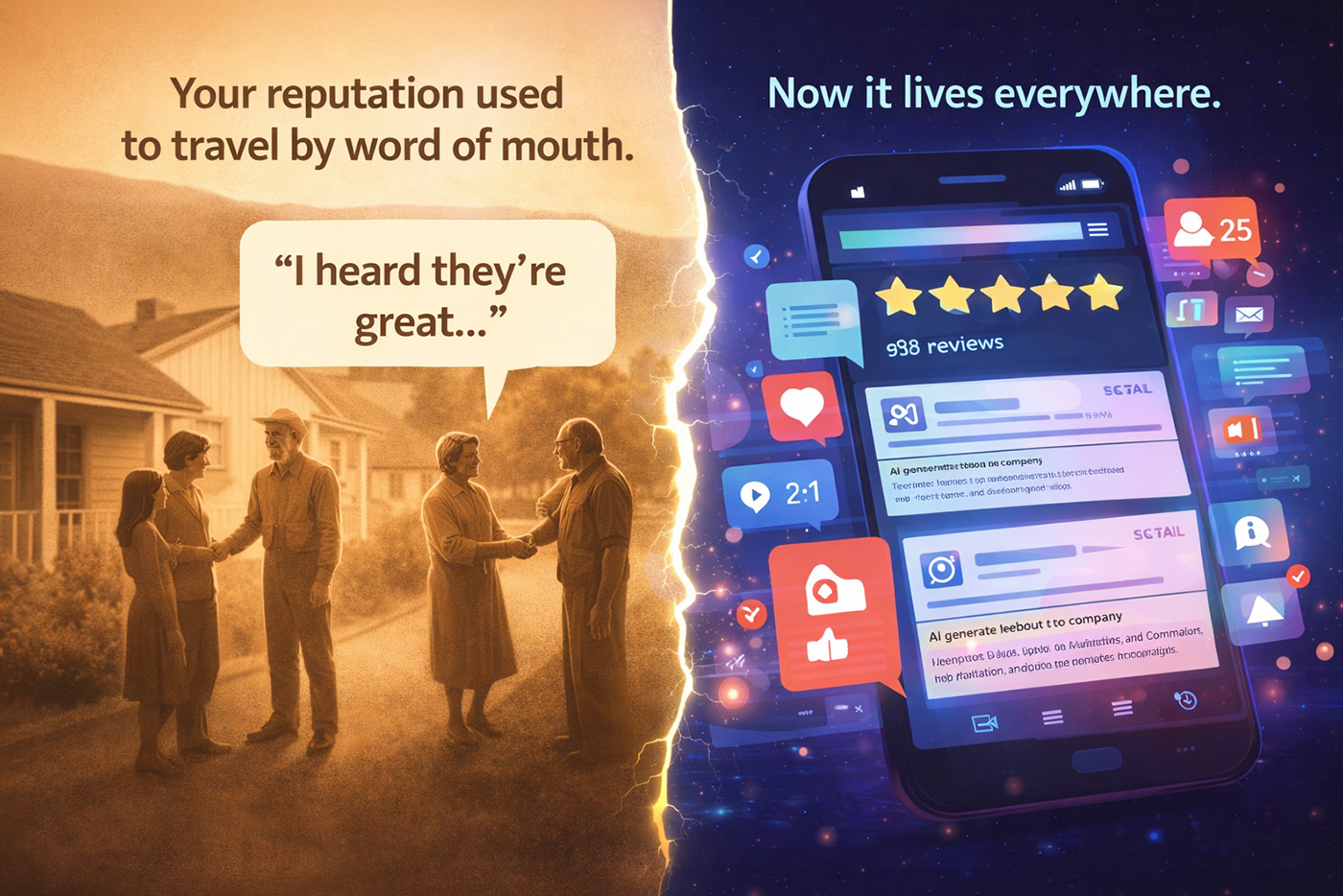
Same logic applies now, different platform.
Back in 2012, I wrote a post called “Sticks & Stones: Managing Your Online Reputation.”
The advice was practical for the time. Set up a Google Alert for your company name. Respond quickly to negative reviews. Don’t be afraid to let complaints appear on your Facebook page — because at least there, you can see them and respond. Yelp, Angie’s List, the Better Business Bureau. That was the landscape.
I reread it recently and the thing that struck me wasn’t how wrong it was. It was how small the problem was back then.
The stakes have changed considerably.
What reputation meant in 2012
In 2012, online reputation management was essentially reactive. Someone left a bad review somewhere. You found it (hopefully before it ranked in search). You responded professionally. You tried to bury it with positive content. Rinse, repeat.
The channels were limited and relatively slow. Google, Yelp, Angie’s List, the BBB. Your Facebook wall. If you were monitoring those and responding promptly, you were ahead of most businesses.
The advice I gave then — remain professional, acknowledge the complaint, offer a solution, show prospective customers you care — that part is still true. Human beings still respond to businesses that handle criticism well.
But the problem has grown several floors taller.
What reputation means now
Here’s what has changed: your reputation is no longer just about what people say about you. It’s about what the internet says about you when someone isn’t even looking for complaints.
Think about how your prospects actually research vendors now. Yes, some still read Google reviews. But a lot of them are asking AI.
“Who are the best HubSpot partners for a mid-size B2B company?”
“What does a HubSpot portal audit actually involve?”
“Is [your company name] legit?”
The answers that come back from ChatGPT, Perplexity, Google’s AI Overview — those aren’t pulling from Yelp. They’re synthesizing your entire digital footprint. Your website. Your LinkedIn. Your blog. Your case studies. Whether other credible sources reference you. Whether your name appears in conversations about the problems you solve.
In 2012, a Google Alert was sufficient to know what was being said about you. In 2026, you need to understand what an AI model thinks your expertise is — and whether it knows you exist at all.
The new version of the Angie’s List problem
In 2012, I told a client: yes, you want bad reviews to show up on your Facebook page, because at least there you can respond. The logic was — visible complaints you can address beat invisible complaints that fester somewhere you’ll never find them.
Same logic applies now, different platform.
If a prospect asks an AI assistant about HubSpot partners and your name doesn’t come up, that’s not neutral. That’s a problem. You’re not being reviewed badly — you’re not being mentioned at all. That’s the 2026 version of having zero reviews.
The businesses that show up are the ones that have built a searchable body of expertise. Published thinking. Real case studies with outcomes. Content that answers the questions buyers are actually asking.
What this means for B2B service providers specifically
This is where I want to be direct with you.
If you’re a consultant, an agency, a solutions partner — your reputation is now almost entirely built on demonstrated expertise, not star ratings. Nobody’s going to Yelp to find a HubSpot implementation partner. They’re searching, reading, asking AI tools, and checking LinkedIn.
The question isn’t “what are people saying about us?” The question is “when someone in our space tries to find what we know how to do — do they find us?”
That means:
A website that actually explains how you work and what you’ve produced. Not a brochure. Evidence.
Case studies with real numbers, not “we helped a client improve their process.”
A consistent content presence on the topics you want to be associated with. You can’t be known for HubSpot data governance if you’ve never written about HubSpot data governance.
Reviews that speak to expertise, not just “great to work with.” Clients who will say in writing what you actually did for them and what changed because of it.
The part from 2012 that still holds
One thing I said in the original post has aged perfectly.
A negative review responded to quickly and professionally can actually become a positive for your company. It shows prospects that you’re paying attention and that you take accountability seriously.
That dynamic hasn’t changed. What’s changed is the surface area. Now it’s not just reviews. It’s every piece of public-facing content you’ve ever published. Every question you’ve answered. Every result you’ve documented.
Your reputation is the sum total of everything the internet can find out about you when no one is looking for something to complain about.
That’s a bigger job than setting up a Google Alert.
But it’s also a bigger opportunity — because most of your competitors still think reputation management is just damage control.
If you’re not sure what your digital footprint actually says about you — or what it’s missing — that’s something I look at as part of a broader digital presence review. Get in touch.