

The Psychology of Motivation — Then and Now
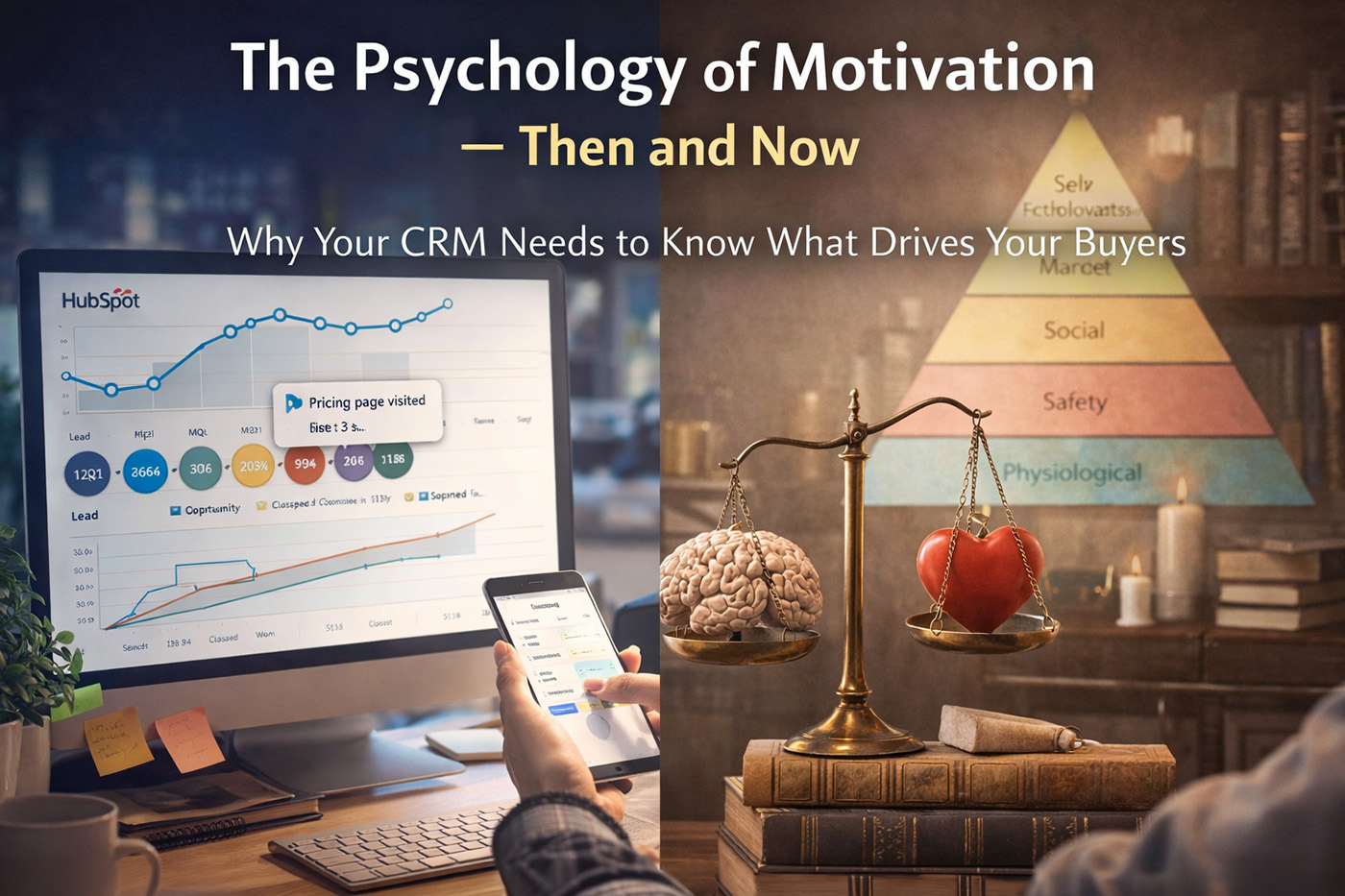
It’s about having a CRM that reflects reality.
Editor’s note: The original version of this article was published in Website Magazine in 2013 under my byline — which their current site has since misattributed. The research and the ideas are mine, noted at the end of the article.
It was real then. It’s still real.
A long time ago — 2012 to be exact — I wrote an article for Website Magazine called The Psychology of Motivation. I was in the middle of a Human Factors degree, deep in the research on what actually makes people act, and I was fascinated by how little of it was showing up in digital marketing strategy.
The premise was simple: external motivators — the big discount, the flashy offer, the arrow pointing at the button — weren’t the real drivers of behavior. The real drivers were internal: needs, thought processes, and emotions. And most websites were completely ignoring them.
That was true then. It’s still true now. What’s changed is that we finally have the tools to do something about it.
Quick recap of the framework
(because it still holds up)
The original article broke internal motivation into three categories:
Needs — The things that are essential, rooted in the subconscious. Hunger, safety, connection. In 2012, the practical advice was: put food photos front and center on a restaurant site. Show happy people. Use water imagery on travel sites. You’re triggering need-based responses before the visitor is even consciously aware of it.
Thought processes — Motivation shaped by past experience and future expectations. The stereotypical pushy car salesman creates friction not because he’s present, but because he lives in the buyer’s memory. Trust signals — reviews, certifications, security badges — exist to counter the bad experiences people have already had elsewhere.
Emotions — The most volatile and least controllable driver. A visitor arrives at your website carrying a whole day’s worth of emotional weight you know nothing about. What you can do is reduce friction, use imagery intentionally, and avoid creating frustration — because frustration is an emotion too.
That framework came out of academic research in human factors and motivational psychology. It was real then. It’s still real.
Here’s what’s changed: we can now act on it.
In 2012, understanding buyer psychology was a design problem. You tried to apply it through your website visuals, your copy, your layout.
In 2026, it’s a data problem. And HubSpot is where that data lives — if you’ve set it up right.
Let me run through the same three categories and show you what they look like inside a CRM that’s actually working.
Needs — now called “buyer intent”
A prospect visiting your pricing page three times in a week isn’t just browsing. That’s a need signal. It’s the digital equivalent of a customer who keeps picking up a product in a store and putting it back down.
HubSpot’s behavioral tracking — page visits, email clicks, document opens — is a needs detector. But only if you’re using it. Most portals I audit have this data sitting unused, with no workflows triggered by high-intent behavior and no alerts going to the sales team.
If you want to understand what’s already in your portal, start here: Stop Hunting for Info Inside Your Own CRM.
Thought processes — now called “lifecycle stage”
The original article talked about how past experience shapes motivation. A bad experience creates hesitation. A positive expectation creates momentum.
In HubSpot terms, this is your lifecycle stage logic — and it’s one of the most misunderstood tools in the platform. A contact who downloaded a guide two years ago and never engaged again is not a “Lead.” Treating them like one and dropping them into a sequence will trigger exactly the kind of negative thought process the original article warned about: “Here we go again. Another company that doesn’t know who I am.”
I wrote about why this matters in depth here: The Most Misunderstood Tools in HubSpot.
Lifecycle stages, used correctly, let you meet people where they actually are — not where you wish they were.
Emotions — now called “personalization”
The 2012 version of emotional motivation was about imagery and ease of use. Reduce friction. Show happy people. Don’t make visitors squint at tiny fonts.
That’s still valid. But emotional resonance in 2026 runs through your outreach — the email that arrives at exactly the right moment, that references the thing they actually care about, that doesn’t feel like it was sent to 40,000 people at once.
That’s what HubSpot’s segmentation and smart content are built for. And it’s why I keep coming back to the same question in every audit: do your sequences feel like they were written for a person, or for a list?
The answer usually tells you everything about how well the emotional layer of your marketing is working. For a deeper look at how the email side of this has evolved — on both sides of the “then vs. now” conversation — check out Email Marketing: Then and Now.
The part that hasn’t changed at all
The original article ended with this: intrinsic motivators are more powerful than incentives and awards.
That is still true. Your prospects are not primarily motivated by your discount codes and your feature lists. They’re motivated by need, by experience, and by feeling understood.
Your HubSpot portal is either helping you deliver on that — or it’s getting in the way. A messy CRM with bad lifecycle data and untargeted sequences doesn’t just underperform. It actively works against the psychology.
The tools have caught up to the research. The question is whether your strategy has.
Want to see how your HubSpot setup is actually performing against the buyers you’re trying to reach? Let’s talk.