Podcasting Was a Buzzword. Now It’s a Pipeline Strategy
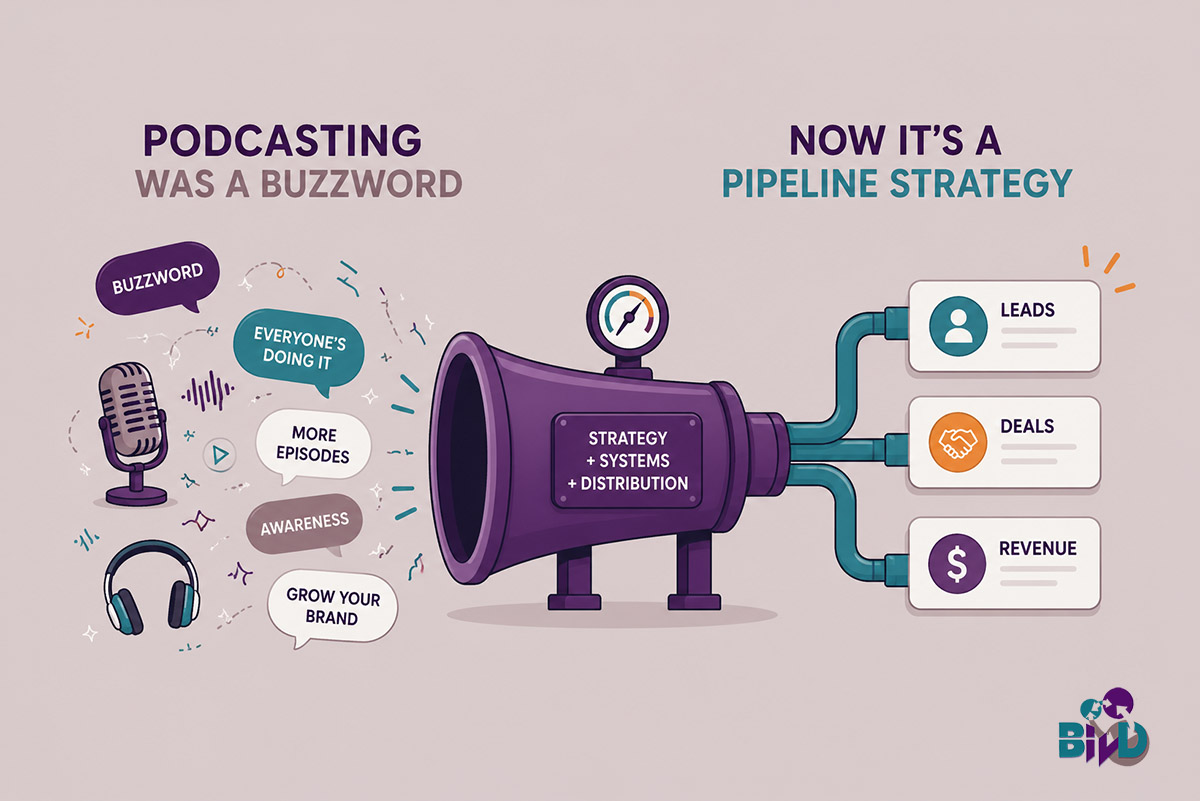
People will voluntarily listen to your message.
What “podcasting” really means in 2026
In 2006, I wrote a post called Podcasting, the New Buzzword. I was genuinely excited about it. The idea that a small business in Wichita, Kansas could distribute audio content to an unlimited audience — without a radio station, without a network, without a budget — felt revolutionary.
I predicted the podcasting audience would hit 10 million by the end of 2006.
It’s 2026. There are over 4 million podcasts. Hundreds of millions of people listen every week. Somewhere between “buzzword” and “ubiquitous,” podcasting grew up — and so did the strategy around it.
Here’s what I got right, what I got wrong, and what it all means for your business today.
What I got right
The original post made one observation that has aged better than anything else: people will voluntarily listen to your message.
That sentence is the whole game. It’s why content marketing works. It’s why inbound beats outbound. It’s why a well-built HubSpot portal will always outperform a cold call list — because when someone opts in to hear from you, the entire dynamic of the relationship changes.
In 2006, podcasting was the first mainstream format where that was true at scale. You didn’t interrupt anyone. They came to you.
That principle hasn’t changed at all. What’s changed is everything around it.
What’s changed
Back then, the technical barrier was the story. I spent half the post explaining what RSS meant, which microphone to buy, how to encode an MP3. The platforms I listed — Odeo, FruitCast, Podcast Alley — are either gone or completely irrelevant now.
Today, you can record a podcast on your phone, edit it with AI tools, distribute it to every major platform in one click, and have a transcript ready for repurposing before you’ve finished your coffee.
The technical barrier is gone. The strategic barrier is what stops most businesses now.
And that’s a very different problem.
The question nobody was asking in 2006
In 2006, the question was: can we do this?
In 2026, the question is: what do we do with it?
A podcast episode — or a video, or a webinar, or a YouTube short — generates a trail of data that most businesses completely ignore.
Who watched? For how long? Did they click through? Did they become a contact? Did that contact eventually become a customer?
In a HubSpot portal that’s set up correctly, every piece of content you create — including audio and video — feeds the same system. Someone listens to your podcast, clicks the link in the show notes, fills out a form, and enters your CRM with a source, a lifecycle stage, and a behavior trail you can actually act on.
Most businesses create content and then lose the thread. The content lives on a podcast platform. The lead lives in a spreadsheet.
The sale happens somewhere else. Nobody connects the dots.
That’s not a content problem. That’s a systems problem. And it’s exactly what a proper CRM setup is designed to solve.
What “podcasting” really means now
The format has exploded — but more importantly, it’s merged with everything else. Video podcasts. Short clips distributed as social content. Transcripts repurposed as blog posts. Audio embedded in email campaigns.
The word “podcast” barely covers it anymore. What we’re really talking about is owned audio and video content — content you control, that builds an audience you own, that feeds a system you can measure.
That’s a long way from “here’s how to use Audacity and submit to Yahoo! directories.”
If you’re creating content in any format and you’re not tracking what happens after someone engages with it, you’re doing the 2006 version of this. You’re excited about the microphone. You haven’t thought about the pipeline.
The good news: the tools to connect content to revenue exist right now. Most of them are already inside your HubSpot portal. The question is whether your strategy has caught up to your content — and if you want to figure out where the gaps are, let’s talk.
A few things that haven’t changed at all
- Content that teaches still wins.
- Audiences reward consistency.
- Showing up in someone’s ears (or eyes) regularly builds a kind of trust that ads never will.
- The best marketing doesn’t feel like marketing.
I knew that in 2006. It’s still true. The rest is just execution.
The original post that inspired this one is still live — Podcasting, the New Buzzword — written in 2006 when an iPod was still a status symbol. Worth a read just for the nostalgia.