
How much does your anchor weigh?
April 26, 2007
Having links from outside sources is an important part of search engine positioning. The more sites that link to your site, the more your site is deemed to be relevant to the search query. That, in turn, will move your site higher in the search engines.
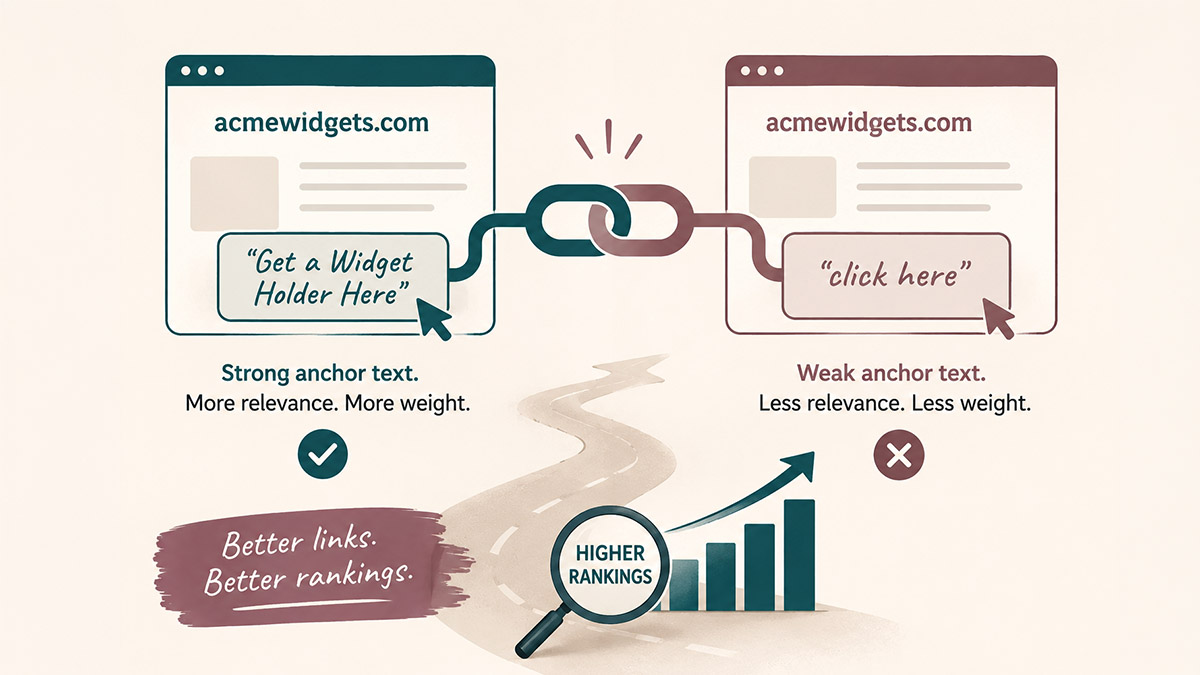
The text that is attached to each link is called “anchor text” and the better your anchor text, the more relevant the link is deemed to be. In other words, your anchor has more weight.
For example: If a link on “acmewidgets.com” to your site “betterwidgetholder.com” has the text “Get a Widget Holder Here”, the link is relevant because it has the same information that (presumably) would be on your page – widget holders.
If, however, the link from “acmewidgets.com” to your site “betterwidgetholder.com” just said “click here”, then that link is not going to have much weight in giving your site more relevance. Unless, of course, you are in the “click here” market.
While getting links to your site naturally is the best way to go, there are occasions when you may decide to exchange links with suppliers, customer websites, etc. In that case, you have the ability to request what verbiage is going to be linked to your site. Unless your company name states your strongest key terms, take the time to ask the company that will be linking to you to use the right terms.
The best way to be sure you get the most relevant link is to make a request like this: “When linking to our company site could you use ‘Better Widget Holders’ as the text that will link to our site?”
Sometimes you may need to give the complete programming code so the reciprocating site company can just place it in the site and the result comes out the way you want. And in the link back to the other company, be sure you do the same – give them the best terms for the link anchor text.
At this point, you may be wondering how to know what sites link to you. That’s very easy. Go to the search engine you wish to check and type in “link:yourdomainname.com.” The results displayed will be sites that link to your website. You can then check to see what the link text says and even request a change from the other site if necessary.
In this search you’ll also find links that are your website – these are internal links.
Internal links, (Links within your website that link directly to other pages in your website) also carry anchor text. These should be treated the same way as external links. For example, many sites have the following pages: home, about, faq, contact, etc. and the internal link (the link within the site to those pages) has exactly the same text: home, about, faq, contact, etc.
Instead, those links should read: About Better Widgets (key term), Widget FAQ (term again), and Better Widget Contact (key term). Caution: It would be very easy to name all of your links with key terms, but then you may run the risk of putting the term too many times on the site. It’s best to make a few changes and then wait a few weeks for the site to be crawled and the position to change. A little patience here will assure that you move upward in the search engines instead of being penalized and moving down for having the same phrase too many times.
Links are highly regarded by search engine marketing companies because referral traffic can represent 20% of all traffic to a website. In addition, as previously stated, links are an important part of determining the relevance of the site for search engines.
Teajai Kimsey is a HubSpot Solutions Partner and Upwork Top Rated Plus consultant serving small and mid-size B2B companies. She works directly with clients — no handoffs, no junior staff. View the HubSpot Work Portfolio, contact Teajai.