I Ran HubSpot’s AEO Grader on My Own Site. Here’s the Honest Result.
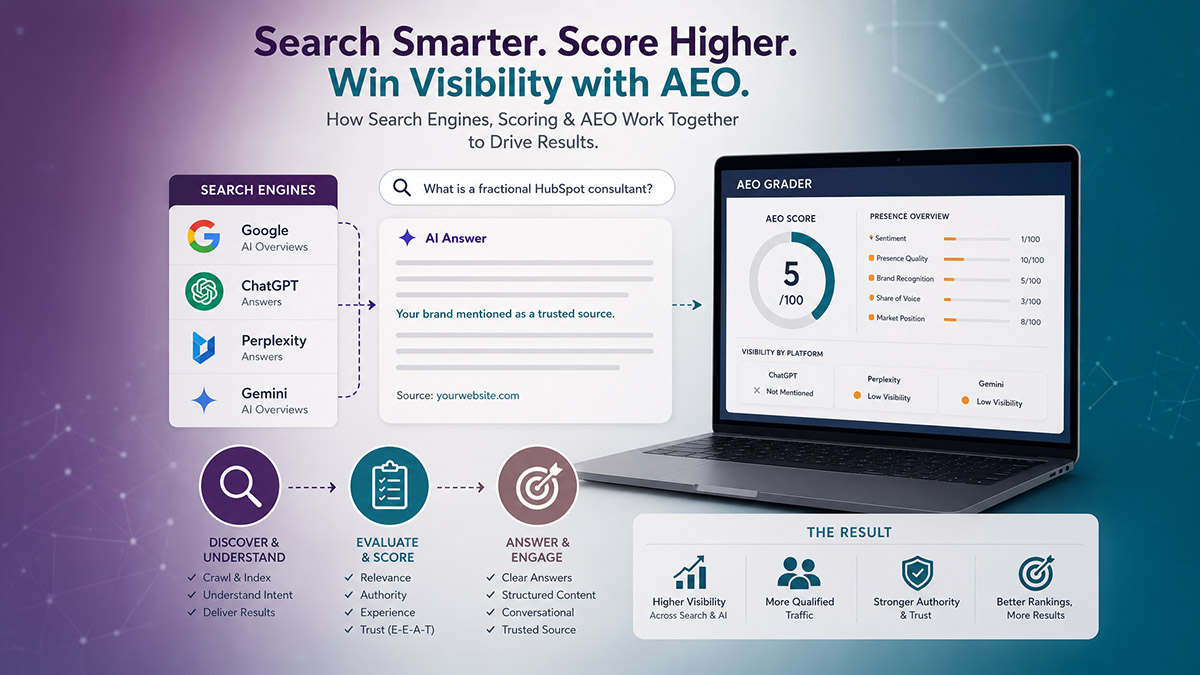
HubSpot’s new AEO Grader checks how ChatGPT, Perplexity, and Gemini currently represent your brand across five scored dimensions:
Sentiment, Presence Quality, Brand Recognition, Share of Voice, and Market Position. I ran it on my site and scored zero out of seven target queries. Here’s what that means, why it’s actually useful data, and what solo HubSpot consultants should do about it.
As a HubSpot Solutions Partner and Upwork Top Rated Plus consultant (top 3% worldwide) who’s been writing about search since 2007, I have a specific vantage point that agency-written AEO content doesn’t: I ran this on my own brand, in real time, and I’m giving you the actual number.
Back in 2007, I wrote about what I called the secret equation for ranking well in Google. I quoted Seth Godin, who was quoting Google’s own engineers:
“If you want to be on the front page of matches for ‘White Plains Lawyer,’ then the best choice is to build a series of pages that give people really useful information.”
That was it. That was the whole secret. Give people genuinely useful information, and the algorithm rewards you — because the algorithm is trying to do what searchers are trying to do. Meet the expectation of the person asking the question, and Google follows.
Eighteen years later, the secret equation still works. But the scoreboard just changed.
What Is AEO — And Why It Replaced the Old Ranking Game
In 2007, the question was: *does your site rank on page one of Google?*
In 2026, the question is: *does an AI answer with your content when someone asks a question you should own?*
Same equation. Different output format.
When someone asks ChatGPT “what does a fractional HubSpot consultant do?” or asks Perplexity “is it better to hire a HubSpot agency or a freelancer?” — something answers them. It might be pulling from an agency’s blog post. It might be a content farm. It might be nobody in particular.
The goal is for that answer to come from you.
That’s AEO — Answer Engine Optimization. Some call it GEO (Generative Engine Optimization) — the terms are mostly interchangeable. HubSpot just made it an official product at Spring Spotlight this year. They launched a free AEO Grader that checks how ChatGPT, Perplexity, and Gemini (including Google’s AI Overviews) currently represent your brand, and a paid monitoring tool at $50/month — or included in Marketing Hub Pro and Enterprise.
So I ran it on my own site. Here’s what happened.
HubSpot AEO Grader Results: Zero Out of Seven (And What That Tells Me)
Unfortunately, my site showed up in zero of the seven target queries I ran.
I’m going to let that sit there without sugarcoating it, because the honest version is more useful than the polished version.
Here’s the context: my site isn’t ranking heavily in traditional search yet either. I’ve been building the content foundation — the right way, the same way I’ve been saying since 2007 — and that takes time. So the AEO result isn’t a surprise. It’s a data point, not a verdict.
What it *is* telling me is that there’s no runway left to wait.
What the Competitive Landscape Actually Looks Like Right Now
I also ran an AEO competitive scan across the queries I want to own. A few things stood out.
Fractional HubSpot admin support is getting crowded — but it’s still all agencies. Orange Marketing, Media Junction, Web Canopy Studio, HIVE Strategy. Not a single solo practitioner ranks here. The gap is real, and it’s exactly the kind of gap Seth Godin was describing in 2007. The agencies are big. They’re generic. They can’t write from the practitioner’s seat. I can. (More on [what fractional HubSpot admin support actually looks like](https://teajai.com/what-is-fractional-hubspot-admin-support/) if you’re evaluating that option.)
AI + HubSpot workflows is filling up fast. Three new sites appeared in this space just since April. The window is narrowing, which means the urgency is real.
Agency vs. freelance HubSpot consultant — I have [a post that should be appearing in these results](https://teajai.com/hubspot-consultant-vs-agency/). It’s indexed. Google knows it exists. It’s just not structured to answer the question clearly enough yet. That’s a fixable problem — and exactly the kind of thing the original Secret Equation taught me to look at.
The Same Content Principle That Worked in 2007 Still Drives AEO
Here’s what I wrote in 2007: *”Following Google’s lead in meeting the expectations of searchers is the best path toward internet marketing success.”*
Swap “Google” for “AI engines” and that sentence is still true word for word.
The engineers at Google spent years figuring out what people actually wanted when they typed a query. Now the engineers at OpenAI, Anthropic, and Google DeepMind are doing the same thing — except instead of returning ten blue links, they’re synthesizing an answer and presenting it as fact.
The question is still: who answers it best?
What’s changed is *how* you prove you’re the best answer. In 2007, it was inbound links, page structure, and fresh content. In 2026, it’s structured content that answers questions directly, authority signals that AI can verify, and consistent topical depth — what practitioners call topical authority — that establishes you as the source AI engines trust.
The same E-E-A-T signals Google uses to evaluate content quality (Experience, Expertise, Authoritativeness, Trustworthiness) are what AI engines now use to decide who to cite. That’s not a coincidence. It’s the same equation, optimized for a new output format.
Why Solo HubSpot Consultants Have an Advantage in AEO — If They Move Now
This is the part nobody is writing about yet.
The agencies are publishing about AEO. HubSpot’s own blog is all over it. Fast Slow Motion published on it within days of the Spring Spotlight announcement. But every one of those pieces is written from an agency perspective, by content teams, at scale.
Nobody is writing about AEO from the perspective of a solo HubSpot consultant who actually ran the tool on their own site and reported the real number.
That’s practitioner-voice content. And practitioner-voice content is exactly what AI tools are starting to prefer — because it’s specific, it’s credible, and it can be verified. An AI can check whether TJ Kimsey is actually a HubSpot Solutions Partner. It can see the Upwork Top Rated Plus badge. It can cross-reference the credentials.
An agency blog post written by a staff writer doesn’t have that. Structured data and schema markup can reinforce these signals technically, but the content itself has to carry the authority first. That’s where solo practitioners — with real, verifiable track records — have a genuine edge.
How Solo HubSpot Consultants Should Respond to AEO Right Now
The secret equation from 2007 still works:
Answer the question better than anyone else. For the right audience. With verifiable expertise behind it.
The math is the same. The scoreboard just runs on different software now.
Here’s what I’m doing about my 0/7:
- Publishing practitioner-voice content on the queries I should own — starting with this one
- Structuring every new post to answer the question directly and early, not just eventually
- Making sure my credentials are in the content body, not just the bio, so AI engines can actually find and verify them
- Running the AEO Grader monthly to watch the score move as content goes live
If you’re a small to mid-size B2B company trying to figure out where AI search fits into your content strategy — or whether your HubSpot is actually set up to support any of this — that’s exactly the kind of conversation I’m having with clients right now. I work directly with every client. No handoffs. Reach out if you want to talk through it.
*TJ Kimsey is a HubSpot Solutions Partner and Upwork Top Rated Plus consultant (top 3% worldwide) based in Wichita, Kansas. She’s been writing about search since 2007 — before “algorithm” was a word most marketers knew.*
Want to see how your HubSpot setup is actually performing against the buyers you’re trying to reach? Let’s talk.
TJ Kimsey is a HubSpot Solutions Partner and Upwork Top Rated Plus consultant (top 3% worldwide) based in Wichita, Kansas. She’s been writing about search since 2007 — before “algorithm” was a word most marketers knew.
An update to a post I wrote back in 2007. The game is the same. The scoreboard is different.
Frequently Asked Questions
What is HubSpot's AEO Grader?
HubSpot’s AEO Grader is a free tool that checks how your brand is currently represented by AI engines — specifically ChatGPT, Perplexity, and Gemini. It scores your brand across five dimensions: Sentiment, Presence Quality, Brand Recognition, Share of Voice, and Market Position. It was launched at HubSpot’s Spring 2026 Spotlight event.
What does a zero AEO score mean?
It means AI engines aren’t currently pulling from your content when answering questions in your space. It’s not a penalty — it’s a starting point. For newer sites or sites with thin content, it’s expected. The fix is structured, authoritative content built to answer specific questions directly.
What is the difference between AEO and SEO?
SEO (Search Engine Optimization) focuses on ranking in traditional search results — Google’s ten blue links. AEO (Answer Engine Optimization) focuses on being the source AI engines cite when they synthesize answers. The underlying content principles are similar; the structure and authority signals required are more demanding in AEO.
Why do solo HubSpot consultants have an advantage in AEO?
Because AI engines can verify individual credentials — HubSpot Solutions Partner status, Upwork ratings, years of documented experience — in ways that are harder to fake or scale. A practitioner writing from direct experience produces a different kind of content than an agency content team. That difference is increasingly what AI engines are designed to detect and reward.
What is GEO?
GEO stands for Generative Engine Optimization. It’s often used interchangeably with AEO. Both refer to optimizing content to appear in AI-generated answers rather than traditional search results.