You Don’t Have to Be Original to Be Creative: Then and Now
Almost 20 years ago . . .
Then (April 4, 2007):
You don’t have to be original to be creative. Is anyone truly original? It is said that Mozart never wrote an original melody — instead he made recombinations of other melodies of the time. Did that make him less creative? In fact it made him more creative! The internet itself was not created as a marketing tool for business, it was just a way for the government to share information between agencies. And look at us now, about 12 years later — wow! Some of the best ideas in business are not necessarily original, but the way that they are used to make a business successful are creative. Sometimes it takes someone from the outside looking in to see the way that different concepts can be molded to become creative ideas for a business. Don’t worry about being original — be unexpected!
That post is almost 20 years old. I wrote it after a morning of reading, struck by the idea that Mozart wasn’t inventing melodies out of thin air — he was recombining what already existed into something nobody had heard put together that way before. Same with the internet. It wasn’t built to sell anything. It was a government information-sharing tool that got repurposed into the biggest marketing channel in history.
Now (2026)
I didn’t expect to come back to this post for a HubSpot article. But I keep having the same conversation with clients, just with different words. It used to be “how do we get creative with our website.” Now it’s “what do we do with AI.” And the answer hasn’t changed as much as people think.
I sew. I crochet. I’m still not original.
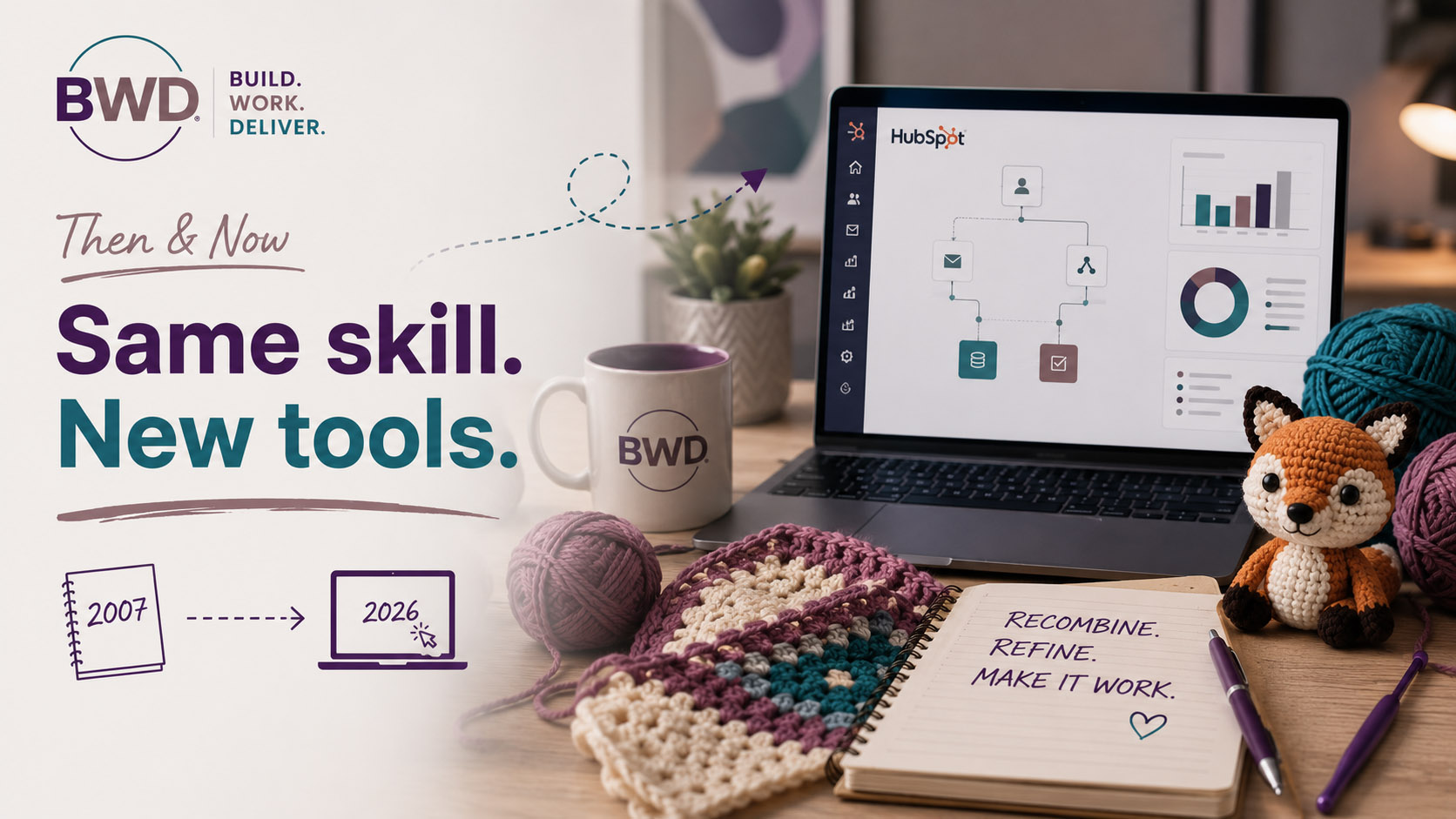
Outside of HubSpot, I make things. I sew, I make t-shirts with sarcastic sayings on them, I’ve made my share of amigurumi crochet animals. And I will be the first to tell you none of it is original. I’m not designing a stitch pattern nobody’s ever seen or inventing a phrase that’s never been printed on a shirt.
What usually happens is someone sees a thing, or describes a thing, and I can make a version of it. That’s the whole skill. Most of the time, what people want isn’t something brand new — it’s a version of something they’ve already seen, made for them. A crochet fox because they saw one at a craft fair and want their own. A shirt with a saying they heard a friend say, in their own voice, sized right, in the color they wanted. Nobody’s coming to me for a concept that’s never existed. They’re coming to me to make the thing real, for them, specifically.
That’s not a lesser kind of creative. It’s the same kind Mozart was doing, just with a crochet hook instead of a piano. And it turns out to be exactly the same skill I use in HubSpot portals every week.
Nobody needs an original AI. They need a recombined one.
The businesses I work with aren’t trying to build a new language model, same as nobody’s asking me to invent a new stitch. What they need is someone to take the tools already sitting in their HubSpot portal — workflows, custom properties, ChatGPT integrations, reporting — and recombine them into something that actually fits how their business runs.
I wrote about this directly when clients started asking whether they should connect ChatGPT to HubSpot at all. The honest answer wasn’t “yes, install the shiny new thing.” It was “depends on what you’re trying to solve, and most of the time the fix is smaller than the AI conversation makes it sound.” Nothing about that is original. HubSpot built the connection. OpenAI built the model. My job is deciding how those pieces get arranged for one specific business — which is exactly the Mozart argument, just with software instead of melodies.
The internet wasn’t built for marketing. AI wasn’t built for your CRM either.
That 2007 line about the internet being a government tool repurposed for business holds up better than I expected. AI followed the same path. It wasn’t designed as a CRM feature. It got adapted into one — by HubSpot, by other platforms, by consultants like me figuring out where it actually helps versus where it just adds noise.
That’s the part people skip. They see an AI feature launch and assume turning it on is the strategy. It isn’t. The strategy is the same thing it’s always been: figure out what your business actually needs, then decide which existing tool — old or new — solves it. Sometimes that’s a shiny AI workflow. Just as often it’s a portal that’s technically been running for years but never actually turned on, or a lifecycle stage nobody bothered to define. Not original. Still the work.
Someone from the outside, looking in
The line in the original post that means the most to me now is the one about needing someone from the outside to see how the pieces fit together. That’s the whole case for fractional HubSpot support — including what happens to a portal when the person who built it leaves and nobody’s watching it anymore. I’m not inventing new marketing theory when I walk into a portal. I’m looking at what’s already there — the data, the workflows, the half-finished automations — and recombining it into something that actually works for that business.
It’s the same reason I’ve never tried to be an agency, and why the HubSpot Solutions Partner badge itself doesn’t mean what most people assume it means. An outside, dedicated set of eyes on your CRM catches things an internal team stops seeing after a while, and it does it without the overhead of a full department. Nothing original about that model either. It’s just arranged the way it needs to be for how small and mid-size B2B companies actually operate.
Be unexpected, not original
Nineteen years later, I’d still write that closing line the same way. Don’t worry about being original. Worry about being unexpected — about putting familiar pieces together in a way nobody else in your space has bothered to. It’s the same thinking behind why I tell people to pick two, not three, when they’re hiring for HubSpot work: there’s no original answer there either, just an honest one. That’s true of a Mozart melody, a repurposed government network, and a HubSpot portal that finally gets used the way it was supposed to be used all along.
Teajai Kimsey is a HubSpot Solutions Partner and Upwork Top Rated Plus consultant serving small and mid-size B2B companies. She works directly with clients — no handoffs, no junior staff. View the HubSpot Work Portfolio, contact Teajai.
The internet wasn’t built for marketing. AI wasn’t built for your CRM either.
Frequently Asked Questions
Do I need original ideas to be creative with my HubSpot portal?
No. Most effective HubSpot setups are a recombination of existing features — workflows, properties, reporting, AI tools — arranged to fit one business’s specific needs. Creativity here is about the arrangement, not invention.
Is connecting AI to HubSpot a good strategy on its own?
Not by itself. AI tools inside HubSpot are only useful when they’re solving a defined problem. Turning on a feature because it’s new isn’t a strategy — deciding what your business actually needs first is.
Why would I need an outside HubSpot consultant if I have an internal team?
An outside perspective often catches gaps internal teams stop noticing over time. A fractional HubSpot admin brings that outside view without the cost of a full in-house hire or an agency retainer.
Get in Touch