

The Business Card Trick that Fixes Trade Show Follow-Up
The Problem: Badges Only Tell You a Name
You know the routine. Three days on a trade show floor, a stack of scanned badges, a sore back from standing on concrete — and then you get home.
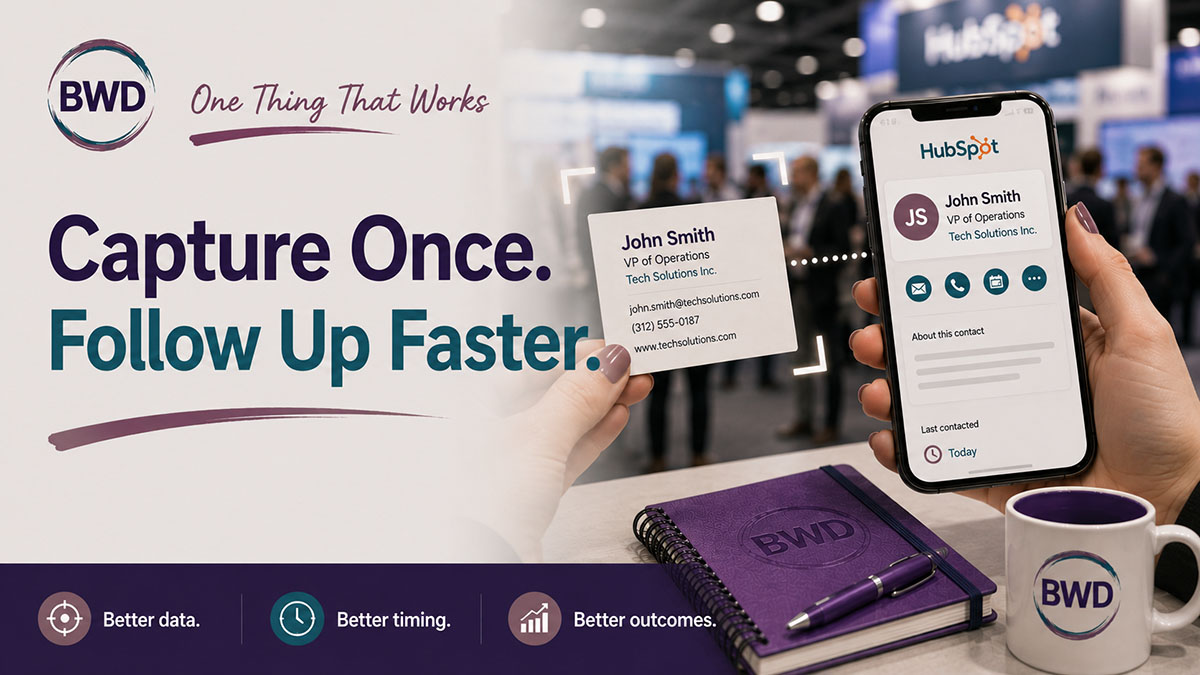
Most event badges are built for check-in, not lead capture. They print a name, sometimes a company. Sure you may have a list to export after, but that extra work causes friection. HubSpot’s mobile app has a free business card scanner built right in — point your phone at a card, and it pulls name, email, phone, job title, and website straight into a contact record. But it can only capture what’s actually printed. Scan a badge, and a badge is all you get.
And here’s the part that should really worry you:
even when the lead capture is good, most teams still don’t act on it in time. Research widely attributed to the Center for Exhibition Industry Research puts it plainly — up to 80% of trade show leads never receive any follow-up at all.
Not a bad follow-up.
None.
The leads that do get contacted within 24 hours convert 6 to 9 times more often than the ones that wait a week or more. By the time most teams get around to it, the prospect doesn’t remember the conversation, let alone your booth.
So you’ve actually got two problems stacked on top of each other: thin data going in, and slow (or no) follow-up coming out. Fix only one, and you’re still bleeding leads.
The Fix, Part One: Make the Badge Scan Optional
Run a small giveaway at your booth. A drawing, a gift card, doesn’t need to be elaborate. The entry ticket isn’t the badge scan — it’s a real business card.
You’ll still badge-scan the casual walk-bys; something is better than nothing. But anyone who stops long enough to want a shot at the giveaway hands over a card with an actual title, email, and direct line — the details that let you follow up like you know who you’re talking to, instead of guessing from a first name and a company logo.
Scan the business card into HubSpot the moment you get it. No shoebox of cards making it home unscanned. No re-entering names from memory two weeks later when half the context — and the urgency — is already gone.
The Fix, Part Two: Enroll Before You Leave the Booth
This is the part most exhibitors skip entirely, and it’s where the real advantage sits.
Once a card is scanned and the contact exists in HubSpot, you’re a couple of taps away from enrolling them straight into a sequence — right there on the show floor, before the conversation goes cold in your memory. Set the sequence to start the day after the event ends, and you’ve got timed, professional follow-up already queued up before you’ve even packed up the booth.
That single setup step is what separates the exhibitors who convert leads from the 80% who let them evaporate. You’re not racing to remember 150 conversations from a hotel room three days later. You’re not waiting for someone back at the office to process a spreadsheet of badge exports. The follow-up is already moving before your flight home lands.
Why It Works
The giveaway flips the incentive — instead of hoping people hand you a real card, you give them a reason to. And immediate sequence enrollment closes the single biggest gap in trade show ROI: the delay between “we met” and “we followed up.” Teams that respond within 24 hours aren’t smarter or better staffed — they just removed the manual step where leads usually die: sitting in a pile, waiting for someone to have time.
What to Try at Your Next Event
– Badge scan for the casual walk-bys — something is better than nothing.
– Run a giveaway with a real business card as the entry ticket for anyone who stops.
– Scan every card into HubSpot on the spot, not at the end of the day.
– Enroll each contact into a follow-up sequence immediately, timed to start the day after the event.
Do all four, and you’ll come home from your next event with a contact list you can actually work — not a stack of cards and badges that make it two weeks before anyone touches them.
Want a hand setting up your next event’s lead capture and follow-up sequence? Let’s connect.
The Problem: Badges Only Tell You a Name
You know the routine. Three days on a trade show floor, a stack of scanned badges, a sore back from standing on concrete — and then you get home.
Most event badges are built for check-in, not lead capture. They print a name, sometimes a company. Sure you may have a list to export after, but that extra work causes friection. HubSpot’s mobile app has a free business card scanner built right in — point your phone at a card, and it pulls name, email, phone, job title, and website straight into a contact record. But it can only capture what’s actually printed. Scan a badge, and a badge is all you get.
And here’s the part that should really worry you:
even when the lead capture is good, most teams still don’t act on it in time. Research widely attributed to the Center for Exhibition Industry Research puts it plainly — up to 80% of trade show leads never receive any follow-up at all.
Not a bad follow-up.
None.
The leads that do get contacted within 24 hours convert 6 to 9 times more often than the ones that wait a week or more. By the time most teams get around to it, the prospect doesn’t remember the conversation, let alone your booth.
So you’ve actually got two problems stacked on top of each other: thin data going in, and slow (or no) follow-up coming out. Fix only one, and you’re still bleeding leads.
The Fix, Part One: Make the Badge Scan Optional
Run a small giveaway at your booth. A drawing, a gift card, doesn’t need to be elaborate. The entry ticket isn’t the badge scan — it’s a real business card.
You’ll still badge-scan the casual walk-bys; something is better than nothing. But anyone who stops long enough to want a shot at the giveaway hands over a card with an actual title, email, and direct line — the details that let you follow up like you know who you’re talking to, instead of guessing from a first name and a company logo.
Scan the business card into HubSpot the moment you get it. No shoebox of cards making it home unscanned. No re-entering names from memory two weeks later when half the context — and the urgency — is already gone.
The Fix, Part Two: Enroll Before You Leave the Booth
This is the part most exhibitors skip entirely, and it’s where the real advantage sits.
Once a card is scanned and the contact exists in HubSpot, you’re a couple of taps away from enrolling them straight into a sequence — right there on the show floor, before the conversation goes cold in your memory. Set the sequence to start the day after the event ends, and you’ve got timed, professional follow-up already queued up before you’ve even packed up the booth.
That single setup step is what separates the exhibitors who convert leads from the 80% who let them evaporate. You’re not racing to remember 150 conversations from a hotel room three days later. You’re not waiting for someone back at the office to process a spreadsheet of badge exports. The follow-up is already moving before your flight home lands.
Why It Works
The giveaway flips the incentive — instead of hoping people hand you a real card, you give them a reason to. And immediate sequence enrollment closes the single biggest gap in trade show ROI: the delay between “we met” and “we followed up.” Teams that respond within 24 hours aren’t smarter or better staffed — they just removed the manual step where leads usually die: sitting in a pile, waiting for someone to have time.
What to Try at Your Next Event
– Badge scan for the casual walk-bys — something is better than nothing.
– Run a giveaway with a real business card as the entry ticket for anyone who stops.
– Scan every card into HubSpot on the spot, not at the end of the day.
– Enroll each contact into a follow-up sequence immediately, timed to start the day after the event.
Do all four, and you’ll come home from your next event with a contact list you can actually work — not a stack of cards and badges that make it two weeks before anyone touches them.
Want a hand setting up your next event’s lead capture and follow-up sequence? Let’s connect.