
Why Companies Leave HubSpot (And Why Most of Them Didn’t Have To)
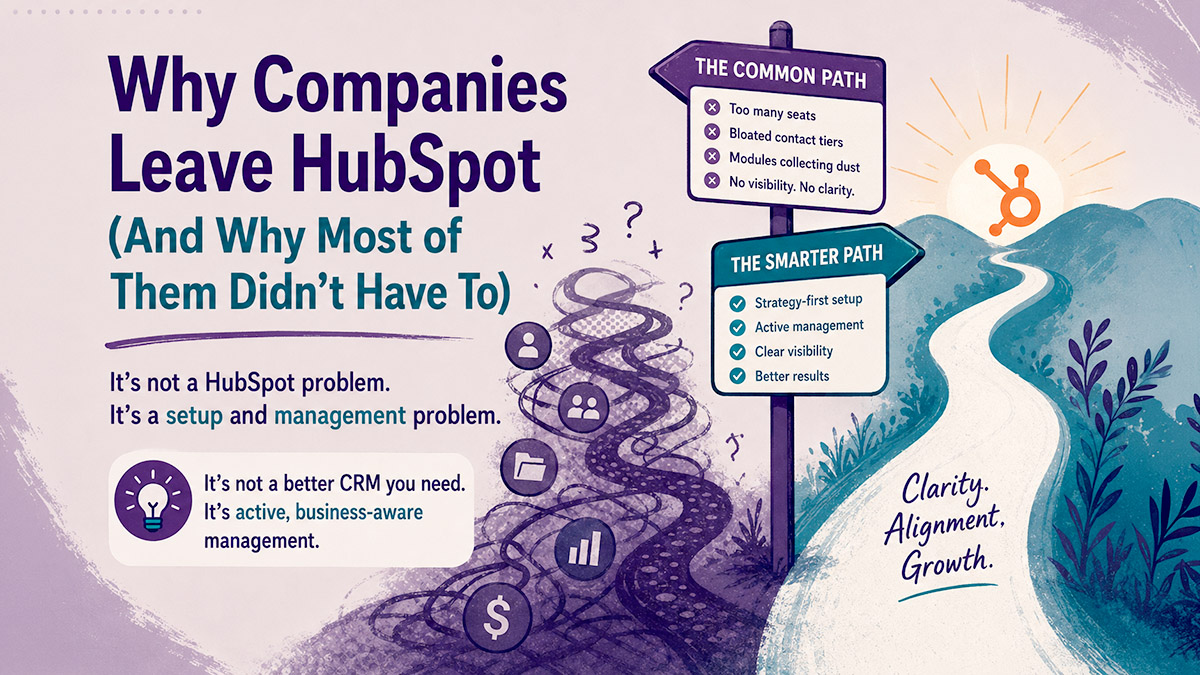
These frustrations aren’t a HubSpot problem. They’re a setup and management problem.
A post is making the rounds on LinkedIn. A business owner explaining why they fired their HubSpot consultant — or never had one — and left the platform after years of overpaying. Too many seats, bloated contact tiers, modules collecting dust.
Sound familiar?
I’ve heard versions of this story more times than I can count. And every time, I have the same reaction: almost none of that had to happen.
HubSpot Isn’t the Problem
I’ve been inside more HubSpot portals than I can count — my own included. I have a business degree. I’ve run my own company. And what I can tell you is this: the frustrations that post describes aren’t a HubSpot problem. They’re a setup and management problem.
HubSpot is powerful. It’s also perfectly happy to let you overprovision yourself into a budget nightmare if nobody’s paying attention. Seats add up. Contact tiers creep. Tools get purchased on a good idea in Q1 and forgotten by Q3. The platform doesn’t flag it. It just keeps running — billing you the whole time.
What’s missing isn’t a better CRM. It’s someone who understands both the business and the tool.
What Happens Without It
I worked with a regional mortgage lender — two operating brands, active sales team, a third-party loan origination system syncing deal records into HubSpot. On paper, they had a solid setup. In practice, they weren’t integrating the program managing loans. Lead routing existed but manual ownership overrides had broken the automation. And leadership had no visibility into whether any of their marketing spend was actually producing closed loans.
Nobody had done anything wrong. The integration vendor had gaps. Internal team members were making manual changes that made sense in the moment but were quietly breaking everything downstream. Without someone actively watching the portal — and understanding the business well enough to know what “broken” even looked like — it just kept running. And compounding.
That’s not a HubSpot failure. That’s what happens when a complex system runs without active management.
The HubSpot Consultant Gap Nobody Talks About
Most companies go one of two directions with HubSpot. They hand it to a marketing coordinator who knows the platform but doesn’t have the business context to make strategic decisions. Or they hire an agency that builds something solid, hands over the keys, and moves on to the next client.
Neither is wrong. But neither is ongoing, business-aware management either.
When nobody’s actively watching your portal, you end up exactly where that LinkedIn post describes. Paying for things you stopped needing. Locked into tiers that made sense 18 months ago. Feeling like the platform is working against you.
It’s not. It just doesn’t have anyone managing it with both eyes open.
What Good Management Actually Looks Like
It’s not just clicking around and pulling reports. It’s looking at your contact database and seeing a cost center. Understanding that a workflow isn’t just automation — it’s a business process with real implications. Knowing when a problem inside HubSpot is actually a feed problem upstream, and escalating it correctly instead of chasing it in circles.
It’s asking “why are we paying for this?” before the renewal lands in your inbox, not after.
That’s a different skill set than most in-house teams have. And it’s more than most agencies are structured to provide on an ongoing basis. An agency’s job is to build and move on. Active management is an entirely different engagement model.
Before You Cancel, Ask Yourself This
Did you ever have someone actively managing your HubSpot portal with both the business and the platform in mind?
For most companies, the honest answer is no.
That’s not a criticism — it’s just a gap in how the industry works. Companies buy HubSpot, get it set up, and assume the work is done. It’s not. A CRM isn’t a one-time project. It’s an ongoing system that needs to evolve as your business does — new hires, new processes, new integrations, contract renewals that need someone asking hard questions before you sign.
That’s exactly the gap I built my practice around.
If you’re not sure your HubSpot investment is working as hard as it should be, let’s talk.
Can I hire someone to manage my HubSpot portal for me?
Yes — and for many small to mid-sized businesses, it’s the smarter move over hiring in-house or working with a full agency. A fractional HubSpot consultant manages your portal on an ongoing basis without the overhead of a full-time employee.
What's the difference between a HubSpot agency and a freelance consultant?
Agencies typically handle implementation and move on. A fractional HubSpot consultant stays involved — actively managing, right-sizing, and optimizing your portal as your business changes.
Why do companies end up overprovisioned in HubSpot?
Usually because nobody’s monitoring usage against cost. Seats, contact tiers, and add-ons accumulate without a strategic review. Ongoing management catches this before it becomes a budget problem.