
What Is Fractional HubSpot Admin Support — And Do You Actually Need It?
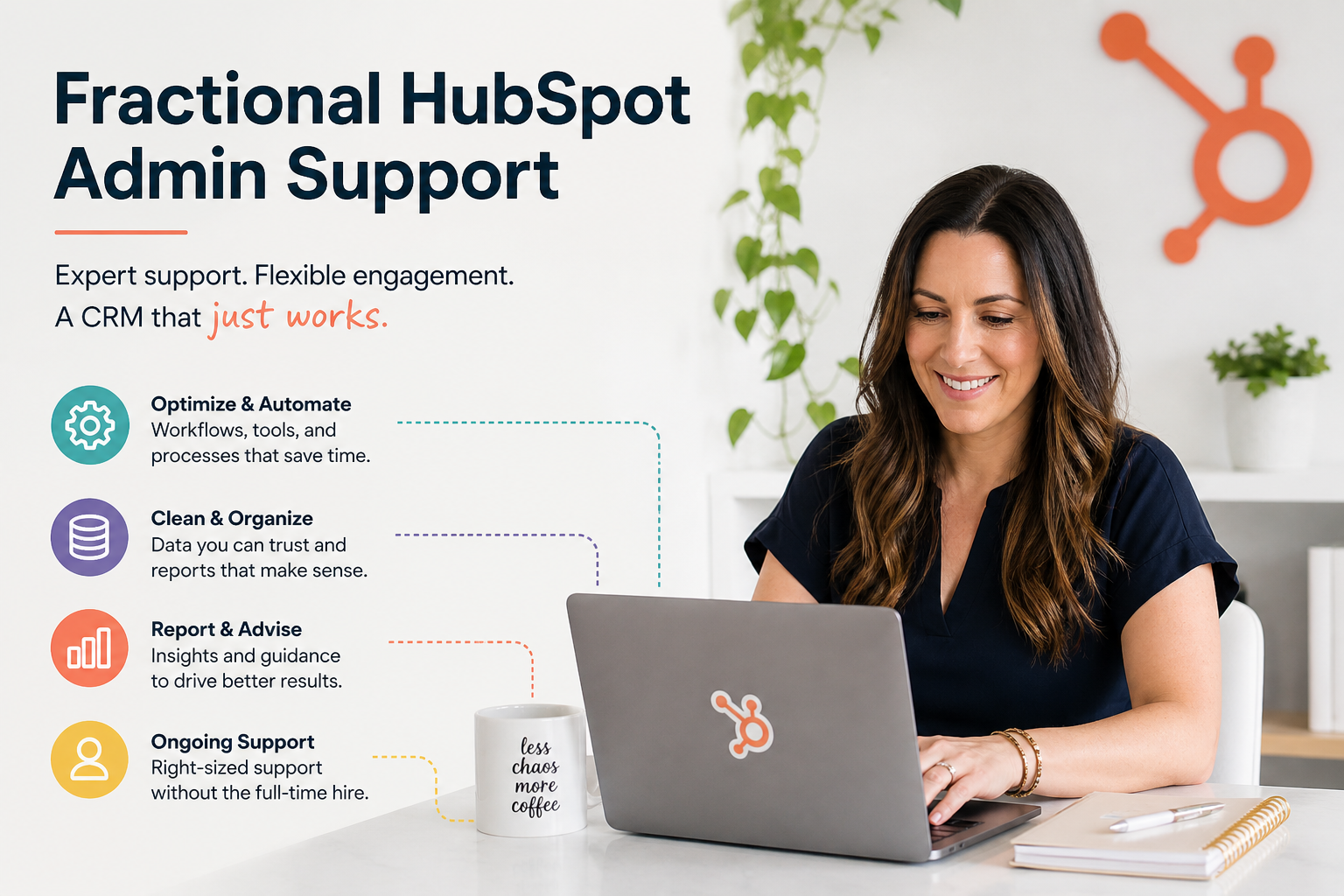
Whether it’s 5 hours a month or 20. The point is consistent, knowledgeable attention.
Fractional HubSpot admin support means hiring a certified HubSpot expert on a part-time or retainer basis
to manage, optimize, and maintain your portal — without the cost or commitment of a full-time hire. You get the expertise without the salary, the benefits, and the onboarding process that takes three months before anyone actually touches anything.
If you’ve been running HubSpot with whoever has time — or it’s sitting half-configured because the person who set it up left — this is probably what you need.
The Conversation I Have More Than Any Other
Here’s what I hear constantly.
Not from small companies who are struggling. From smart companies — companies with real revenue, real teams, real HubSpot subscriptions — who pull me in and say some version of this:
“We know we’re not using it like we should.”
That sentence carries a lot. What they mean is: they bought HubSpot with good intentions. They onboarded. They built some workflows. Someone on the team became the unofficial HubSpot person — usually because they were the most patient, not because they were trained for it.
And then things got busy. The workflows kept running. New contacts kept coming in. Deals kept moving through the pipeline. On the surface, it all looked fine.
But the reports stopped making sense. The team started keeping parallel spreadsheets because they didn’t quite trust what the CRM was telling them. And the unofficial HubSpot person either burned out or left — and took three years of institutional knowledge with them.
That’s not a HubSpot problem. That’s a maintenance problem. And maintenance is exactly what fractional admin support is designed to solve.
Here’s the harder truth: HubSpot doesn’t work right out of the box. It was never designed to. The platform is powerful precisely because it’s configurable — but configuration requires ongoing attention, not just a one-time setup. What most companies have isn’t a broken HubSpot. It’s an unattended one.
What Fractional Admin It Actually Includes
Think of it like having a mechanic on retainer. Not someone you call when the engine light comes on and you’re already on the side of the road. Someone who checks in regularly, knows your specific vehicle, and catches the small things before they become expensive things.
Nobody changes their oil because they enjoy it. They change it because the alternative is an engine rebuild.
A fractional HubSpot admin handles the ongoing work that keeps your portal functioning the way your business actually operates — not the way HubSpot defaults to when nobody’s been paying attention. That typically includes: CRM maintenance.
Duplicate contacts. Lifecycle stages that haven’t been touched since setup. Properties nobody fills in because they were never made required. I audit this with every new client and I have yet to find a portal that doesn’t have all three.
Workflow management. Your automations were built for how your business worked then. If your process has changed — new products, new team, new go-to-market motion — your workflows probably haven’t kept up. This is where things quietly break without anyone noticing until a lead falls through the cracks and someone has to explain it.
Reporting and dashboards. This one comes up in almost every first call I have. Leadership looks at the dashboard and asks what something means. That shouldn’t require a footnote. When a report needs explaining, it’s not doing its job.
Email and campaign support. Keeping the marketing contact list clean, monitoring deliverability, supporting campaign setup and segmentation. Unsubscribed contacts don’t stop counting toward your tier. Most people don’t realize that until they see the bill.
Day-to-day optimization. Required fields nobody’s filling in. Stages that don’t reflect reality. Integrations that stopped syncing cleanly six months ago and nobody noticed. This is the ongoing housekeeping that keeps the foundation solid.
Your team’s questions. Being available when someone on your team hits a wall — instead of them waiting three days for a HubSpot support ticket to route to the right person.
The scope varies. Some clients need 5 hours a month. Others need 20. The point is consistent, knowledgeable attention from someone who actually knows your portal — not a fresh set of eyes every time you have a question.
Who This Is Actually For
I’ll be honest: not everyone needs fractional admin support. Some companies are better served by a one-time setup or a targeted project. But fractional admin is the right fit in a few very specific situations.
You’re a small to mid-size B2B company using HubSpot for CRM, marketing, or sales — but you don’t have the volume or the budget to justify a full-time HubSpot person on staff. You need the expertise without the headcount.
Your portal is running but not really working. This is the most common one. Everything technically functions. Emails go out. Deals are in the pipeline. But the most dangerous state for a CRM isn’t broken — it’s “mostly working.” Because when it’s mostly working, nobody calls in reinforcements. They just work around it. The team uses workarounds. Reports get questioned in meetings. There’s a gap between what HubSpot is supposed to be doing and what it’s actually doing — and nobody has time to figure out why.
Your HubSpot admin just left. This is the urgent version. When the person who knew the portal walks out the door, the tribal knowledge goes with them. Suddenly nobody knows why a workflow was built a certain way, or what that property was supposed to track, or whether it’s safe to change a lifecycle stage definition. A fractional admin can step in, audit what’s there, document it, and keep things from deteriorating while you figure out the next step.
You’re scaling and the portal hasn’t kept up. New reps. New product lines. New territories. HubSpot was configured for where you were eighteen months ago. That gap between then and now is where revenue leaks. And companies leave HubSpot for exactly this reason — not because the platform failed them, but because the platform never had the ongoing attention it needed to succeed.
You’re just getting started and you want it done right from the beginning. The cost of fixing a badly configured portal is almost always higher than the cost of setting it up properly. This is the one I wish more companies thought about before they were already in cleanup mode.
What It Costs — And Why the Comparison Matters
This is usually where the conversation gets interesting.
A full-time HubSpot administrator in the US costs $65,000–$95,000 in base salary. Before benefits, payroll taxes, recruiting costs, and the three months it takes before they’re actually up to speed on your specific portal. For a lot of companies, that’s not a hire that makes sense — the role doesn’t need 40 hours a week, and the budget doesn’t support it.
A HubSpot agency offering fractional or managed services typically starts at $3,000/month. Sometimes significantly more. You’ll get a team — which sounds reassuring — but you’ll also get an account manager who translates between you and the person actually doing the work. More people in the chain. Slower turnaround. Higher overhead baked into every invoice.
An independent fractional HubSpot admin — particularly one who holds Solutions Partner status — typically runs $1,000–$3,500/month depending on scope. You work directly with the person doing the work. No handoffs. No account manager. No junior staff learning on your portal while you pay senior rates.
For a lot of businesses, that’s been the answer all along. It just wasn’t obvious because nobody named it.
Agency, Full-Time, Fractional or “Freelance” — Which One Do You Actually Need?
Since we’re on the topic of cost, it’s worth being direct about the comparison. HubSpot agency or freelance consultant — which one do you actually need? The answer depends on what problem you’re actually trying to solve.
A HubSpot agency is best for project-based work — a big implementation, a major overhaul, a specific campaign build. But for ongoing admin, you’re often paying agency overhead for work that doesn’t require it. And the HubSpot Solutions Partner badge doesn’t always mean what you think it means — tier level alone isn’t a reliable indicator of fit or quality.
A full-time admin makes sense when HubSpot is genuinely complex enough to occupy someone 40 hours a week. For most B2B companies under 100 employees, it isn’t.
Fractional, sometimes called freelance, is the middle ground — consistent expert attention, direct access, without the overhead. Think good, cheap, fast — pick two. Fractional admin lets you optimize for quality and value without sacrificing either.
What to Look for When You’re Hiring
Not everyone who lists HubSpot as a skill on their profile is equipped for this. Here’s what actually matters.
HubSpot Solutions Partner status. This is the credential that separates people who’ve read the documentation from people who’ve done the work. It requires active certifications, demonstrated client results, and an ongoing relationship with HubSpot. It’s not self-designated.
A real track record. Case studies. Client comments. Portfolio work. Ask specifically about companies similar to yours in size and industry. Results in one context don’t always translate to another.
Direct access. You want to talk to the person doing the work. If the first conversation involves multiple people and someone whose title includes the word “manager,” you’re looking at an agency model even if it’s not being called that.
Multiple certifications. HubSpot certifies across every hub. A well-rounded admin holds several. Ask which ones — and when they were last updated.
Someone who tells you what you actually need. Not the maximum scope. The right scope. The first conversation should involve a lot of questions about your situation — not a pitch about everything they can do for you.
The Distinction I Keep Coming Back To
There’s a difference between a portal that runs and a portal that works.
Running means contacts are coming in, emails are going out, deals are in the pipeline. Nothing is technically broken. The lights are on.
Working means your reports tell a story leadership can act on without someone in the room to translate. Working means your automations do what they’re supposed to without anyone babysitting them. Working means your team actually uses the system — because it reflects reality instead of fighting it.
Most portals I audit are running. Fewer are actually working.
The gap between the two is usually not dramatic. It’s accumulated — small misalignments, outdated configurations, properties nobody uses, stages that don’t match the actual sales process. Individually, none of it seems urgent. Together, it adds up to a system that requires workarounds to use and apologies to explain.
Do you actually know if your HubSpot is working? That’s not a rhetorical question — it’s the right starting point. And if the honest answer is “not really,” that’s exactly what a fractional admin is there to fix. A fractional or “freelance” admin keeps you in the working category. Not just the running one.
Is a Freelance HubSpot Admin the Right Fit for You?
Here’s the simple version.
If HubSpot is central to how your business finds, converts, and retains customers — and you don’t have a dedicated person keeping it aligned with how your business actually operates — something is slipping. Whether you feel it yet or not.
Fractional admin support is the answer when a full-time hire is too much and an agency is too expensive and too impersonal. It’s the local mechanic model: one person, direct access, someone who drives it before handing it back.
I work with small and mid-size B2B companies as a solo HubSpot Solutions Partner based in Wichita, Kansas. Every client works directly with me. If you’re not sure where to start, a HubSpot portal audit is almost always the right first step — it tells you exactly what’s there, what’s broken, and what to prioritize so you’re not guessing.
What is fractional HubSpot admin support?
Fractional HubSpot admin support is a part-time or retainer engagement with a certified HubSpot expert who manages and maintains your portal on an ongoing basis — without the cost of a full-time employee. It typically covers CRM maintenance, workflow management, reporting, email deliverability, and ongoing optimization.
How much does fractional HubSpot admin support cost?
Pricing typically ranges from $750 to $3,000 per month depending on scope and the provider. Independent HubSpot Solutions Partners generally cost less than agencies while offering more direct access. Agency-based managed services typically start at $3,000/month and climb. A full-time internal HubSpot admin runs $65,000–$95,000/year in salary alone — before benefits or recruiting costs.
What's the difference between a fractional HubSpot admin and a HubSpot agency?
With a fractional admin — especially an independent one — you work directly with the person doing the work. At a HubSpot agency, you typically work with an account manager who coordinates with a technical team. That adds overhead, slows turnaround, and raises cost. An independent fractional admin gives you faster response, lower cost, and direct access to the expert.
Do I need a HubSpot Solutions Partner for fractional admin support?
It’s not technically required, but Solutions Partner status is the clearest signal of credentialed expertise in the HubSpot space. Partners hold active certifications, maintain a direct relationship with HubSpot, and have demonstrated client results to earn and keep the designation. It’s the closest thing to a verified credential available.
How many hours per month does fractional admin support typically require?
It depends on your portal’s size and activity level. Smaller portals with lighter usage often need 5–10 hours per month. Mid-size companies with active marketing, live sales pipelines, and regular workflow updates typically need 15–25 hours. A good fractional admin will scope this honestly after looking at your specific situation — not sell you the maximum.
What happens when my HubSpot admin leaves the company?
This is one of the most common triggers for fractional support. When an internal admin leaves, their institutional knowledge of the portal goes with them — why workflows were built a certain way, what properties track what, what’s safe to change. A fractional admin can step in quickly, audit what’s there, document it properly, and maintain continuity while you figure out the next step.
Teajai Kimsey is a certified HubSpot Solutions Partner and Upwork Top Rated Plus consultant (top 3% worldwide) with 25+ years of digital marketing experience. She works directly with B2B companies as a fractional HubSpot admin and HubSpot consultant — no junior staff, no hand-offs.