How to Track Real Marketing ROI in HubSpot Using Campaign Influence
If you’ve ever struggled to answer the question,
“Which of our marketing efforts actually lead to revenue?”
you’re not alone.
Most teams try to piece together custom reports, UTM links, email data, deal data, and spreadsheets… and still don’t get a clear answer. But HubSpot already has a built-in feature that bridges the gap automatically:
Campaign Influence.
And yes, it really does work — if you set it up correctly. This blog walks through:
- How campaign influence works
- Real examples of how it impacts pipeline
- Why adding budget and anticipated revenue to campaigns is essential
- Why campaigns outperform custom reports for high-level ROI
And most importantly: why ROI matters, even for people who insist they “don’t care about ROI.”
How HubSpot Campaigns Create Automatic Revenue Attribution
When someone engages with a campaign asset like a form, CTA, email, ad, or page, HubSpot stamps their contact record with the recent conversion campaign.
If that contact is later associated with a deal, the campaign automatically receives influence on that revenue.
- No manual tagging.
- No spreadsheets.
- No complex multi-touch attribution.
- Just association + engagement = influence.
Real-Life Examples (These Happen Every Week)
The Webinar That Quietly Produced $84,000
A SaaS client ran a webinar with 210 registrants, 167 attendees, and 47 who asked for the slide deck.
Six weeks later 12 attendees created deals and 3 closed
Total revenue influenced: $84,000
None of that was visible without campaigns. To leadership it looked like “webinars are a distraction.”
Campaign tracking proved it was one of their highest-ROI tactics.
A Basic Ebook That Turned Into Pipeline Fuel
A client created a simple “Beginner’s Guide” ebook. Nothing fancy and definitely not expensive.
But with a little social and email promotion, the ebook garnered 3,200 views and 570 downloads.
Out of that 11 deals were created and 2 closed.
Influenced revenue: $42,750
Custom reports alone would have missed most of this because downloads didn’t always lead immediately to deal creation. Campaign influence made the long tail visible.
A Paid Ad Campaign That Looked Like It Failed… Until Campaign Reporting Proved Otherwise
Google Ads spend: $3,000
Visible direct conversions: 6
Leadership’s opinion: “Let’s turn this off.”
But campaign influence told a different story:
6 direct conversions
+17 influenced deals created after ad engagement
+4 closed deals
Revenue influenced: $116,500
Without campaigns, those influenced deals would have been invisible.
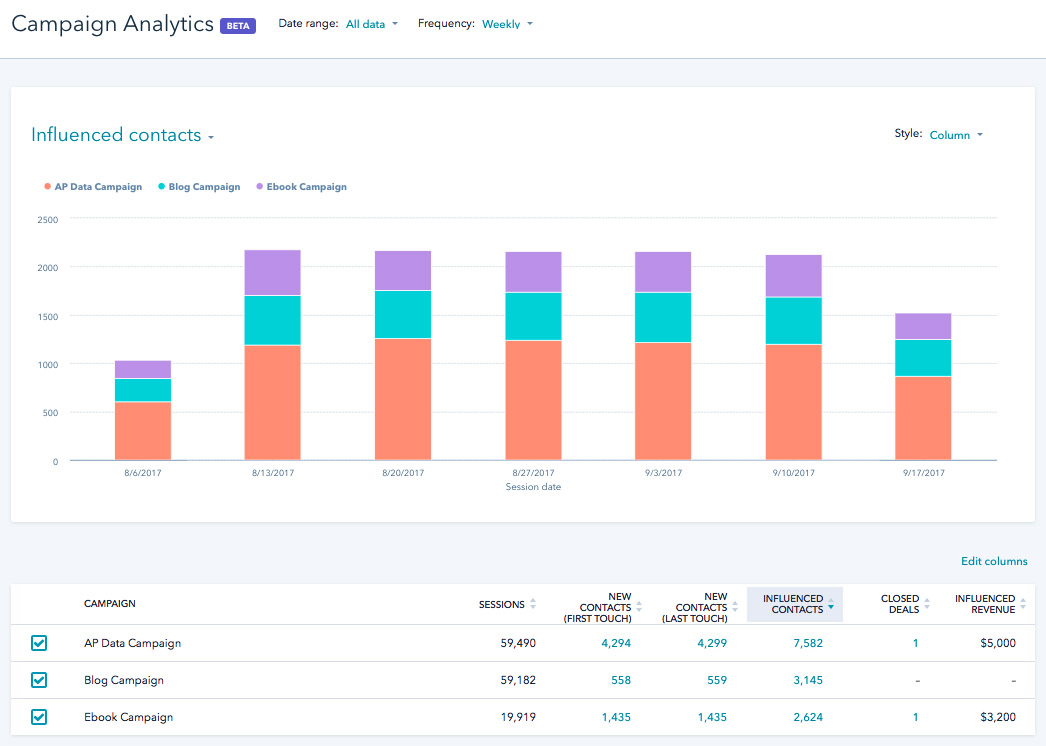
Why Campaigns Beat Custom Reports for Marketing ROI
Custom reports are great — but they can only measure what you explicitly tell them to measure.
Campaigns measure:
- Forms
- CTAs
- Landing pages
- Social posts
- Emails
- Ads
- Website pages
- AND contact conversion history
- AND deal associations
…together, in one place.
You cannot replicate this in a single custom report without rebuilding HubSpot’s attribution logic manually.
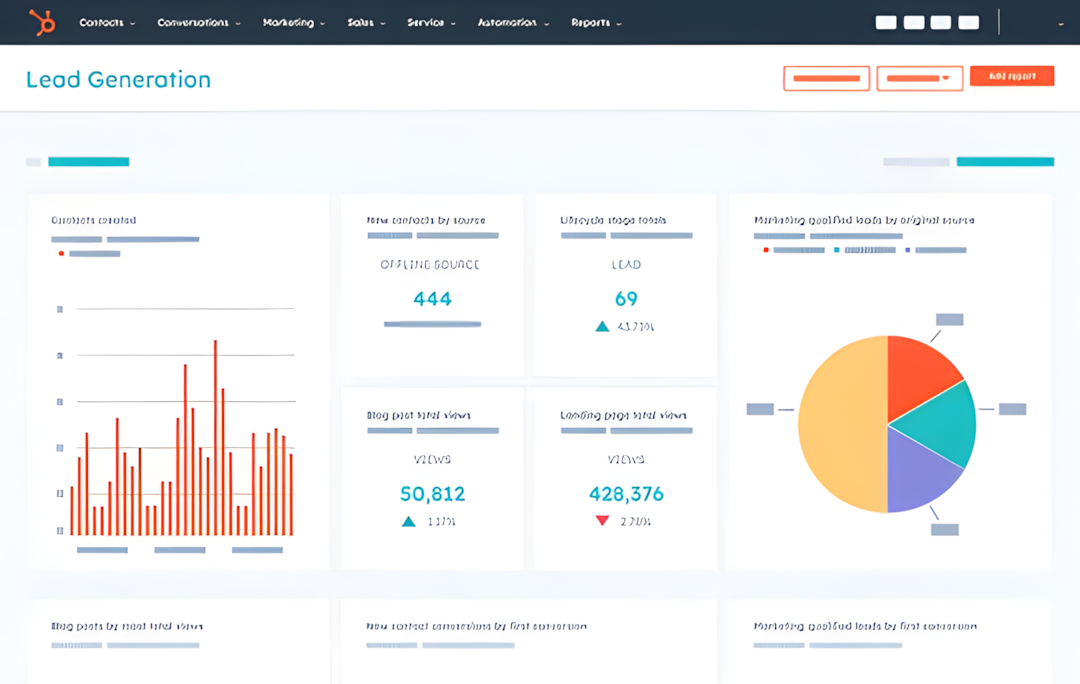
Campaigns are the only space where HubSpot brings all of this together automatically.
Why You Should Add Budget + Expected Revenue to Every Campaign
This is the part teams overlook — but it’s the difference between “interesting data” and actual ROI.
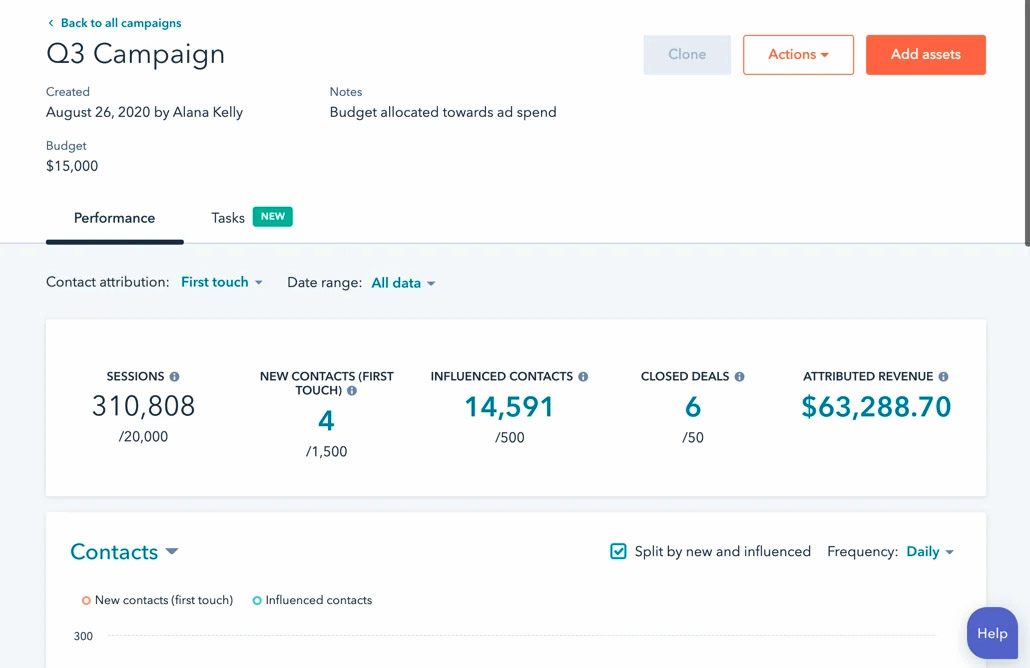
In each campaign, enter:
- Budget: what you spent (ads, creative, labor, anything meaningful)
- Value of a sold customer (average or real): This will calculate sales and forecasted sales against the budget
Why? Because HubSpot will then calculate:
- ROI
- Cost per influenced deal
- Cost per conversion
- Campaign efficiency over time
Without budget, you’re guessing.
With budget, you’re reporting.
This is how you show leadership:
“For every $1 we spent, we generated $8 in influenced pipeline.”
That’s how marketing gets a seat at the revenue table.
Why ROI Still Matters — Even If You Think It Doesn’t
Let’s break it down very simply. ROI answers two questions:
Should we keep doing this?
If something costs $2,000 and returns $40,000,
you should do more of that.
Should we stop doing this?
If something costs $2,000 and returns $0,
you should stop doing that.
That’s it.
ROI isn’t about being “obsessed with metrics.” ROI is just about knowing whether something works and protecting your time and money.
Even organizations that claim they “don’t care about ROI” still care whether they’re wasting resources.
How to Start Using Campaign Influence Today
Here’s your quick setup checklist:
Create a HubSpot Campaign
–Give it a clear name like “2025 Q1 Webinar – AI for Healthcare” or “Sales Email Series – March 2025”
–Assign all assets to it:
- Forms
- Emails
- Landing pages
- Ads
- CTAs
- Social posts
–Include the campaign in your nurture workflows (Yes you can assign workflows to campaigns)
–Add budget and expected revenue
–Review monthly and optimize
Final Thought
Marketing shouldn’t have to fight for credit.
Campaign influence gives you a clear, simple, defensible way to show the impact of your work — without building complicated attribution models.
If you’re not using campaigns to tie marketing activity to revenue, you’re leaving visibility (and budget) on the table.
Need help setting up your campaigns? Contact me.
Why You Should Add Budget + Expected Revenue to Every Campaign
This is the part teams overlook — but it’s the difference between “interesting data” and actual ROI.
In each campaign, enter:
- Budget: what you spent (ads, creative, labor, anything meaningful)
- Value of a sold customer (average or real): This will calculate sales and forecasted sales against the budget
Why? Because HubSpot will then calculate:
- ROI
- Cost per influenced deal
- Cost per conversion
- Campaign efficiency over time
Without budget, you’re guessing.
With budget, you’re reporting.
This is how you show leadership:
“For every $1 we spent, we generated $8 in influenced pipeline.”
That’s how marketing gets a seat at the revenue table.
Why ROI Still Matters — Even If You Think It Doesn’t
Let’s break it down very simply. ROI answers two questions:
Should we keep doing this?
If something costs $2,000 and returns $40,000,
you should do more of that.
Should we stop doing this?
If something costs $2,000 and returns $0,
you should stop doing that.
That’s it.
ROI isn’t about being “obsessed with metrics.” ROI is just about knowing whether something works and protecting your time and money.
Even organizations that claim they “don’t care about ROI” still care whether they’re wasting resources.
How to Start Using Campaign Influence Today
Here’s your quick setup checklist:
Create a HubSpot Campaign
–Give it a clear name like “2025 Q1 Webinar – AI for Healthcare” or “Sales Email Series – March 2025”
–Assign all assets to it:
- Forms
- Emails
- Landing pages
- Ads
- CTAs
- Social posts
–Include the campaign in your nurture workflows (Yes you can assign workflows to campaigns)
–Add budget and expected revenue
–Review monthly and optimize
Final Thought
Marketing shouldn’t have to fight for credit.
Campaign influence gives you a clear, simple, defensible way to show the impact of your work — without building complicated attribution models.
If you’re not using campaigns to tie marketing activity to revenue, you’re leaving visibility (and budget) on the table.
Need help setting up your campaigns? Contact me.