

HubSpot Agency or Freelance Consultant. Which One Do You Actually Need?
If your process is solid and you need someone to run it, hire for execution.
When you want help with your architecture, automation or strategy, should you contact an agency or find a solutions partner?
A prospect asked me this question last week. My honest answer: it depends on what you actually need — and most people are asking the wrong question before they’ve figured that out.
I’ve worked in both seats. I’ve partnered with agencies who own the marketing strategy while I handle the HubSpot side for their clients — building the architecture, setting up the automation, making the platform actually do what the campaign needs it to do. And I work directly with companies who just need someone who knows HubSpot inside and out and can keep it from quietly becoming a mess.
They are not the same job. And the way you choose between them matters more than most people realize.
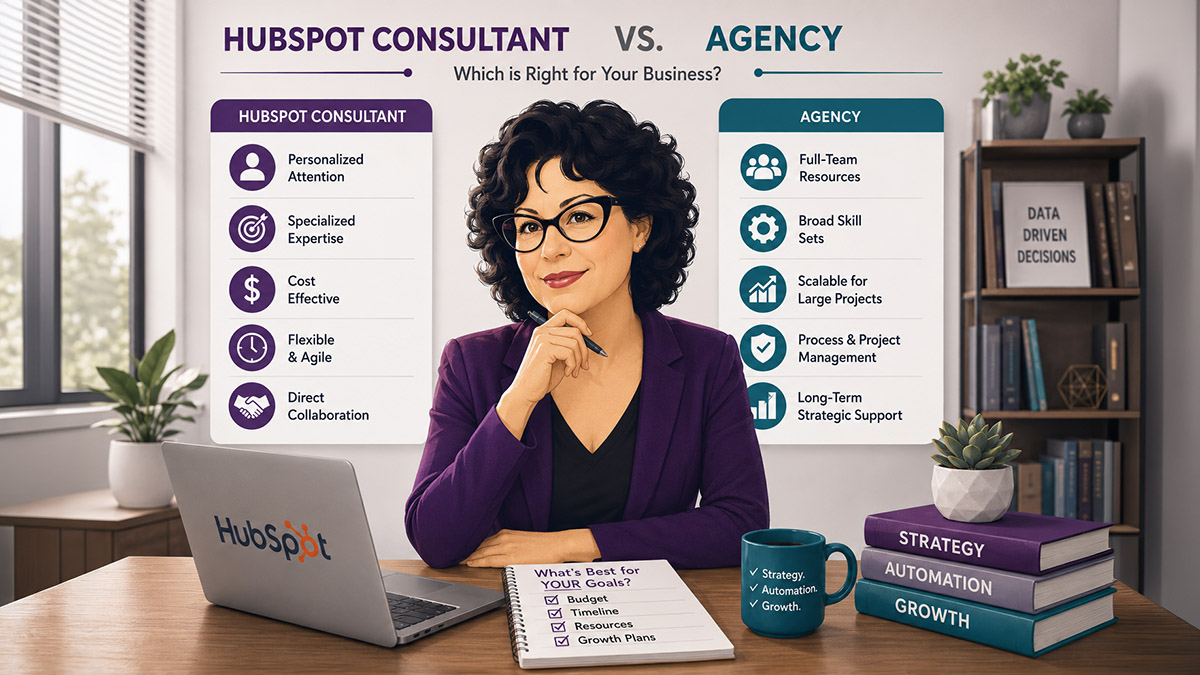
The Comparison: Agency vs. Freelance HubSpot Consultant
| HubSpot Agency | Freelance HubSpot Consultant | |
|---|---|---|
| Who you work with | Account manager + rotating team | Directly with the consultant, every time |
| Platform depth | Varies — depends on who’s assigned | Deep, daily HubSpot expertise across clients |
| Cost | Higher — you’re paying for the full team | More affordable — no overhead, no markup |
| Speed of communication | Filtered through layers | Direct access, faster decisions |
| Best for | Full marketing departments needed from scratch | Companies with existing teams who need HubSpot expertise |
| Flexibility | Structured retainers, scoped engagements | Adaptable to what you actually need |
| Strategic vs. executional | Both, but billed at agency rates | Deep strategy + execution without the cost premium |
| HubSpot Solutions Partner | Often yes, at the agency level | Yes — look for certified individual partners |
What an agency actually gives you
When you hire a HubSpot agency, you’re buying a team. A strategist, a copywriter, someone who runs the ads, someone who knows the platform. If you need all of that — if you’re starting from scratch and don’t have marketing infrastructure in place — that team model makes sense.
Agencies are also built for scale. If you’re running complex multi-channel campaigns, managing a large contact database, and need ongoing creative output, the agency model is designed for that volume.
What you’re paying for is coordination. And coordination costs money.
What a freelance HubSpot consultant actually gives you
A good independent HubSpot consultant — especially one who’s a certified Solutions Partner — is not a cheaper agency. That’s the wrong frame.
What you’re getting is someone who lives inside HubSpot every day, across multiple clients, across multiple industries. Someone who has seen implementations go wrong in every possible way and knows exactly where the landmines are before you step on them.
You’re also getting direct access. No account manager, no handoffs, no “I’ll check with the team.” You talk to the person doing the work.
For small to mid-size B2B companies that don’t need a full marketing department, that combination — platform depth plus direct access — is almost always the better fit.
The mistake I see most often
Here’s what actually goes wrong: companies hire for execution when what’s broken is the foundation.
You bring in an agency to run campaigns, but the HubSpot portal is a disaster. Contacts aren’t segmented, workflows are conflicting, the pipeline doesn’t match how your sales team actually works. Now you’ve got a capable team running the wrong system very efficiently.
Or you hire a freelance admin to manage day-to-day tasks, but the problem isn’t execution — it’s that no one has ever built a proper strategy or architecture for how the platform should work. The admin can keep the lights on, but nothing is getting better.
The question isn’t “agency or freelancer.” The question is: what is actually broken?
If your process is solid and you need someone to run it, hire for execution. If your process is the problem, adding more execution speed just gets you to the wrong place faster.
Where I fit — and why it’s different
I’ve been the HubSpot person inside agency engagements. I know what that relationship looks like from the inside. I also work directly with companies as their fractional HubSpot admin — the person who owns the platform, keeps it healthy, and makes sure it’s actually working for the business.
That experience in both seats gives me a perspective most consultants and most agencies don’t have.
If you’re trying to figure out which model is right for your situation, start with an honest diagnosis of what’s actually broken. Not what you think you need — what the platform and the business actually need.
That’s a conversation worth having before you sign any contract.
Teajai Kimsey is a HubSpot Solutions Partner and Upwork Top Rated Plus consultant serving small and mid-size B2B companies. She works directly with clients — no handoffs, no junior staff. View the HubSpot Work Portfolio, contact Teajai.
Is a freelance HubSpot consultant as qualified as an agency?
Yes — and in some cases more so. A certified HubSpot Solutions Partner consultant holds the same credential as an agency partner, but applies it across a range of clients and industries rather than within a single team’s way of doing things. The credential is the floor; the real differentiator is how much hands-on platform experience they bring.
When does it make more sense to hire a HubSpot agency?
If you’re building marketing infrastructure from scratch — strategy, content, campaigns, and HubSpot all at once — an agency that covers the full scope can make sense. Where agencies become expensive is when you already have a marketing team or strategy in place and just need someone who knows the platform deeply. That’s a consultant’s job, not an agency’s.
What is a fractional HubSpot admin and do I need one?
A fractional HubSpot admin is an experienced consultant who manages your HubSpot portal on an ongoing basis — without the cost of a full-time hire. They keep workflows running, contacts clean, pipelines accurate, and reporting meaningful. If your team uses HubSpot but nobody owns it, you almost certainly need one. The platform doesn’t maintain itself.
How do I know if my HubSpot problem is strategic or executional?
A good diagnostic question: if you had someone excellent running your HubSpot day-to-day tomorrow, would your results improve? If the answer is yes, you have an execution gap. If you’re not sure what “good” looks like for your portal, or if past efforts haven’t moved the needle, the problem is likely upstream — architecture, strategy, or setup. Fix that first. Execution speed doesn’t help if the system is broken.