

SEO Then and Now: What Actually Moves the Needle in 2026
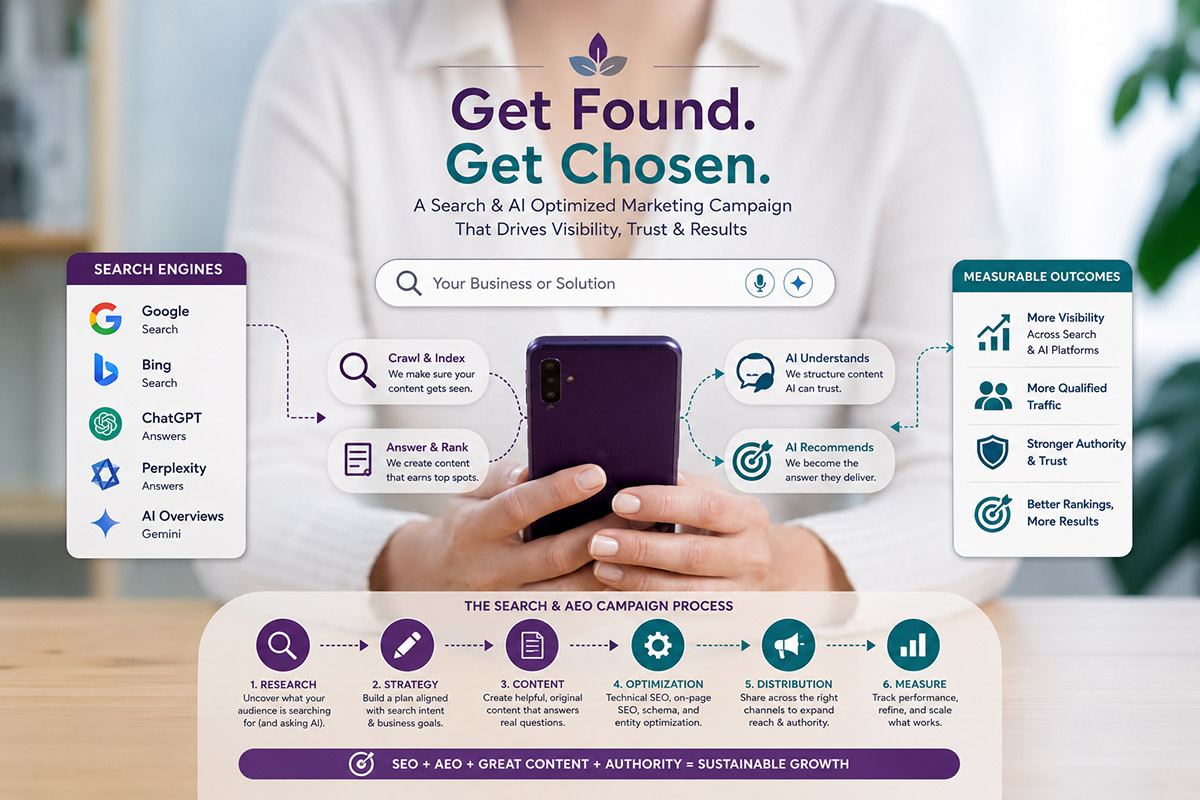
Why is our website traffic down?
I’ve been getting the same question from clients a lot lately. “Why is our traffic down?”
Sometimes it’s framed differently. “We haven’t changed anything — why are our rankings dropping?” Or: “We’ve been doing SEO for years and something shifted.”
They’re not wrong. Something did shift. Actually, a lot of things shifted — and the shift accelerated significantly in the last 18 months.
Back in 2007, I published a post called Top 10 Search Optimization Components
It held up for a long time. Most of what was in it was accurate, practical, and worth doing. But reading it now, it belongs to a different era of the internet — one where getting found meant following a set of technical rules and the algorithm would reward you for it.
That playbook isn’t broken. It’s just incomplete in ways that actually matter now.
Here’s what changed, why your clients are noticing it, and what the new framework actually looks like.
The 2007 Playbook: Signals You Sent to an Algorithm
The original Top 10 came from a survey of the top search professionals at the time. It was a list of technical signals — things you did to your website that told Google you were worth ranking.
In plain terms:
- Title tags told the algorithm what the page was about
- Inbound links from other sites proved you were credible
- Anchor text of those links reinforced your topic
- Internal links built a navigational map for crawlers
- Domain age signaled trust over time
- Keyword usage in page text confirmed topic relevance
- PageRank of linking sites amplified your authority
- The rate of gaining new links showed you were active and worth noticing
It was a signals game. Build the right signals, get the ranking.
And for a long time — honestly, for most of the 2000s and well into the 2010s — that worked. Do the technical things right, produce content with the right keywords, earn some links, and traffic followed.
The clients noticing drops today? Many of them were doing exactly that. Correctly. And it still stopped working.
What Changed and When
The shift didn’t happen overnight. But it accelerated in ways most businesses weren’t watching closely enough.
AI Overviews started taking over the top of Google’s search results in 2024. If your content was previously appearing in position one or two for an informational query, AI Overviews often absorbed that click before a user ever reached your result.
Traffic dropped. Rankings didn’t.
That distinction matters. You can still technically rank and see your organic clicks crater simultaneously. The traditional link between ranking and traffic is no longer as reliable as it was.
Then came AI Mode. At Google Marketing Live 2026, Google confirmed that AI Mode has passed 1 billion monthly active users, and AI Overviews reaches 2.5 billion users globally. These aren’t experimental features anymore. They’re how most people search now.
And queries in AI Mode run 3x longer than traditional search queries.
People aren’t typing two keywords anymore.
They’re asking full questions, follow-ups, context-laden requests. The behavior of search changed before most content strategies had time to catch up.
GML 2026 also made something else clear: the silos between text search, conversational AI, and YouTube have collapsed into a single ecosystem. Search, discovery, and purchase are now interconnected and AI-mediated. What that means for inbound marketing strategy is significant — and most small to mid-size B2B businesses haven’t adjusted for it yet.
The New Top 10: What Actually Moves the Needle Now
This isn’t a replacement for the 2007 list. Some of those fundamentals still apply. What follows is the updated framework — what the signals game looks like when the algorithm has been replaced by something closer to a judgment engine.
- Answer the question directly — early.
In 2007, keyword placement mattered. In 2026, structure matters more. AI engines synthesize answers. If your content buries the response to a question in paragraph five, you’re not competing for the featured answer. Lead with the answer. Then support it. - Topical authority over keyword density.
Ranking for a keyword used to be about using it correctly and often enough. Now it’s about owning a subject area. A consistent body of content that covers a topic from multiple angles signals expertise in a way that a single well-optimized page can’t match. This is why content clusters and pillar pages aren’t optional anymore. - E-E-A-T signals — and making them findable.
Google’s E-E-A-T framework (Experience, Expertise, Authoritativeness, Trustworthiness) has been evolving for years. But AI engines take it further: they’re actively cross-referencing credentials, verifying that the author is who they say they are, and favoring sources they can confirm. Your credentials need to be in the content body — not just in a bio widget at the bottom of the page. - Inbound links still matter — but so does who cites you.
The link-building fundamentals from 2007 didn’t disappear. Authoritative inbound links still help. What’s new is that AI engines also evaluate whether your content is being cited, referenced, or summarized by other credible sources. A mention without a link can now carry weight that it didn’t a decade ago. - Internal linking as topic architecture — not just navigation.
In 2007, internal links helped crawlers map your site. Today, internal linking communicates to AI engines how your content topics relate to each other. A well-structured cluster — with a strong pillar page and supporting posts properly linked — tells the algorithm you’ve gone deep on a subject, not just wide. - Schema markup and structured data.
This one barely existed in 2007. Now it’s table stakes. FAQ schema, article schema, how-to schema — these aren’t optional add-ons. They’re how AI engines extract structured answers efficiently. If your content isn’t marked up, you’re making it harder for AI to choose you. - Conversational content structure.
Search queries are longer now. Brainstorm-style searches are growing 30% faster than any other query type in AI Mode. Your content needs to anticipate how real people ask questions in full sentences — not just how they used to type two-word queries into a search box. - Domain age still matters — but topical consistency matters more.
Old domains with diverse, unfocused content aren’t outranking newer sites with deep topical authority anymore. If you’ve been publishing on every topic under the sun for fifteen years, that history doesn’t help you as much as you’d think. Focused consistency is winning over sprawl. - Content that earns citations — not just clicks.
This is the AEO layer. If an AI engine cites your content when answering a question, that’s a win — even if the user never clicked through to your site. Being the source is the new first-page ranking. The goal has shifted from traffic acquisition to answer inclusion. - Verifiable expertise — in the content itself.
This one connects everything else. AI engines are increasingly sophisticated about distinguishing practitioner-written content from content-farm output. Specific examples, real scenarios, documented credentials, and first-person experience all read differently to AI than generic rewrites of generic information. The more specific and verifiable your expertise, the more likely you are to be chosen as the answer.
What this means for your B2B marketing
If you’re a small to mid-size B2B company and your inbound traffic has softened in the last year, you’re not imagining it. The rules of the game changed significantly — and the clients I’m working with right now are seeing it directly.
The good news: the principle hasn’t changed. Build genuinely useful content, for the right audience, with real expertise behind it. That was the secret in 2007 and it’s still the secret now.
What changed is the definition of “useful.” Useful now means structured to be cited — not just ranked. It means answering the question clearly enough that an AI engine can lift it as the response. It means making your credentials findable so the engine can verify you’re qualified to answer.
If your HubSpot setup isn’t supporting this kind of content strategy — proper blog structure, clear CTAs, landing pages built to answer specific questions, attribution that goes beyond page views — that’s worth looking at. The platform has the tools. It just has to be configured to use them.
Want to see how your HubSpot setup is actually performing against the buyers you’re trying to reach? Let’s talk.
TJ Kimsey is a HubSpot Solutions Partner and Upwork Top Rated Plus consultant (top 3% worldwide) based in Wichita, Kansas. She’s been writing about search since 2007 — before “algorithm” was a word most marketers knew.
AI Overviews started taking over the top of Google’s search results in 2024.
Frequently Asked Questions
Why is my organic traffic dropping even though my rankings haven't changed?
AI Overviews and AI Mode are absorbing clicks that used to flow to organic results. Your content may still rank in position one or two, but when Google’s AI synthesizes the answer directly on the search results page, many users get what they need without clicking through. Rankings and traffic are no longer as tightly correlated as they were before 2024.
What is AEO and how is it different from SEO?
SEO (Search Engine Optimization) focuses on earning rankings in traditional search results — the ten blue links. AEO (Answer Engine Optimization) focuses on being the source AI engines cite when they generate answers. The underlying content principles overlap, but AEO requires more direct question-answering structure, verifiable authority signals, and schema markup. You need both now. SEO alone is no longer sufficient.
Do inbound links still matter for SEO in 2026?
Yes — but the context has expanded. Authoritative inbound links remain an important signal, but AI engines also evaluate citations and references that don’t include a clickable link. Being referenced by credible sources in your space, even without a traditional backlink, now contributes to your authority in ways it didn’t before. Build links, but also earn mentions.
What are E-E-A-T signals and why do they matter?
E-E-A-T stands for Experience, Expertise, Authoritativeness, and Trustworthiness — Google’s framework for evaluating content quality. AI engines use these same criteria to determine which sources to cite. The key shift is that your credentials need to be present within the content itself, not just in an author bio. If you’re a certified HubSpot Solutions Partner, say so — in the post, near the relevant content, where an AI engine can find and verify it.
What should a B2B company do first if their search traffic is declining?
Start with a content audit. Identify which pages are still driving traffic versus which are indexed but invisible. Then look at structure: are your pages answering specific questions directly and early? Do you have FAQ sections with schema markup? Is your internal linking building recognizable topic clusters? Many B2B sites are sitting on good content that’s just structured for a 2015 algorithm. The fix is often architectural, not a full rewrite.